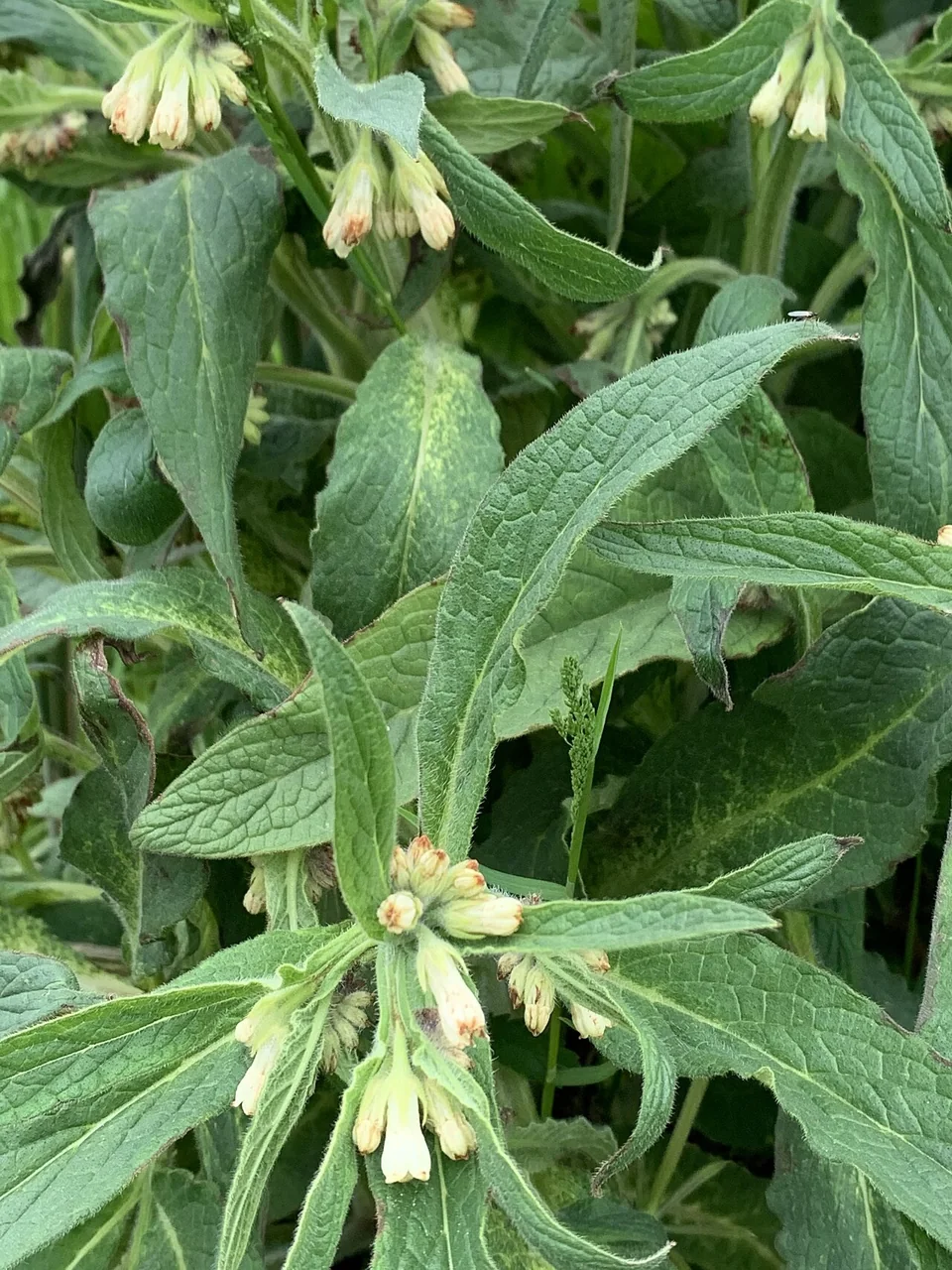
Pollinator plant

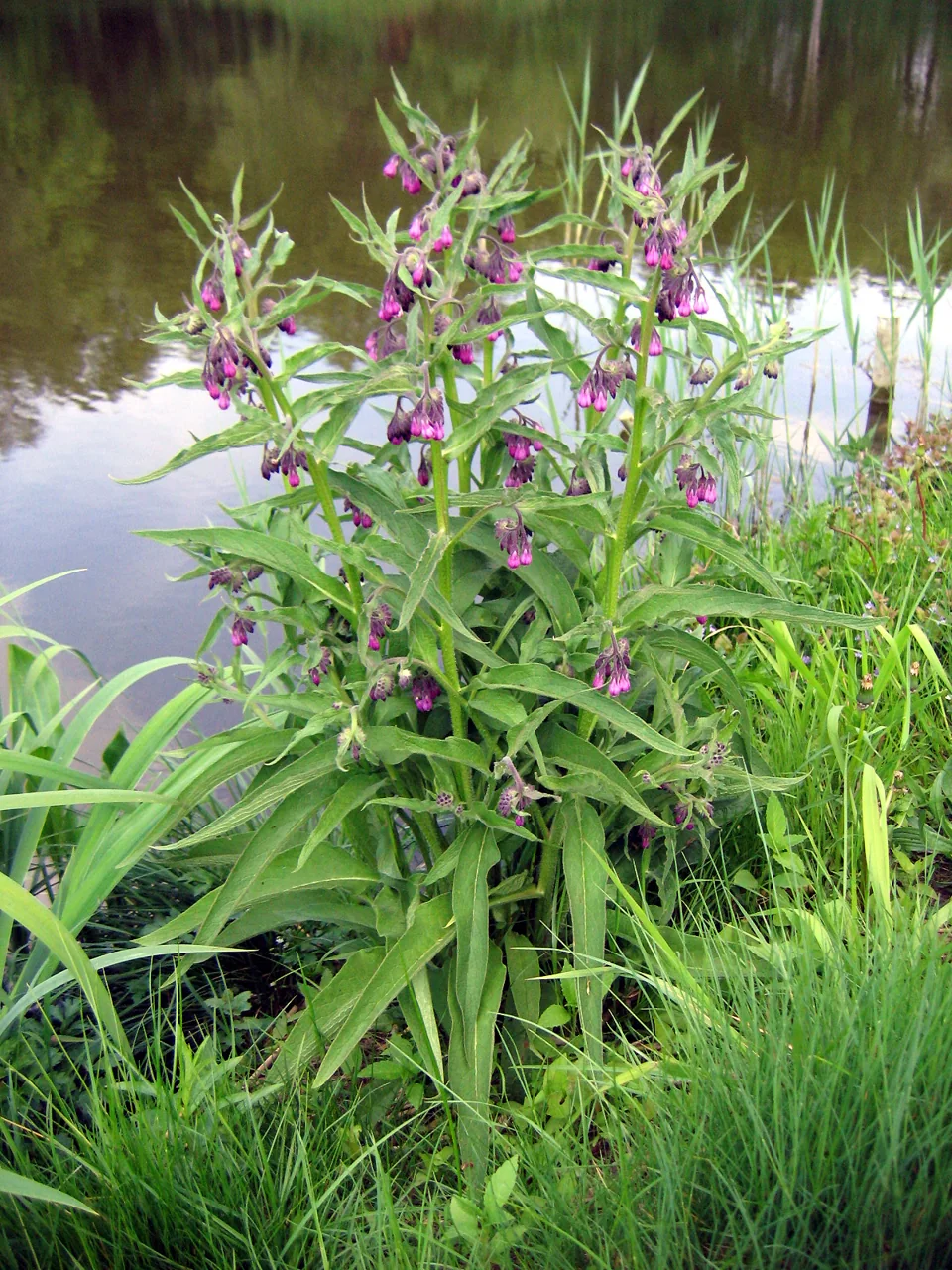
Comfrey

Symphytum officinale

Linked agroforestry plant data
Pollinator recipe

Common names

23 names

Names recorded in our plant catalogue and botanical sources, grouped by language. Usage can vary by region.

Catalogue language labels are reviewed separately from botanical source records.

English
Dutch
  • Gewone smeerwortel[2]
  • Smeerwortel[2]
French
  • Consoude officinale[2]
  • Grande consoude[2]
German
  • Echter Beinwell[2]
  • Gemeiner Beinwell[2]
  • Gewöhnlicher Beinwell[4]
Italian
  • Consolida maggiore[2]
Portuguese
  • Confrei[2]
  • Consolda-maior[2]
Spanish
  • Consuelda[2]
  • suelda consuelda[2]

Numbered references identify names recorded by an external source. Other names are from our plant catalogue.

[1] Symphytum officinale — Plant Toolbox common names ↗

NC State Extension Gardener Plant Toolbox; English common names in a United States horticultural reference.

Source records
  • Comfrey — ul#common_names > li:nth-of-type(4); heading: Common Name(s):; Symphytum officinale.
  • Common Comfrey — ul#common_names > li:nth-of-type(5); heading: Common Name(s):; Symphytum officinale.
  • Boneset — ul#common_names > li:nth-of-type(2); heading: Common Name(s):; Symphytum officinale.
  • Black wort — ul#common_names > li:nth-of-type(1); heading: Common Name(s):; Symphytum officinale.
  • Bruise wort — ul#common_names > li:nth-of-type(3); heading: Common Name(s):; Symphytum officinale.
  • Consound — ul#common_names > li:nth-of-type(6); heading: Common Name(s):; Symphytum officinale.
  • Cultivated Comfrey — ul#common_names > li:nth-of-type(7); heading: Common Name(s):; Symphytum officinale.
  • Knitbone — ul#common_names > li:nth-of-type(8); heading: Common Name(s):; Symphytum officinale.
  • Quaker Comfrey — ul#common_names > li:nth-of-type(9); heading: Common Name(s):; Symphytum officinale.
  • Slippery-Root — ul#common_names > li:nth-of-type(10); heading: Common Name(s):; Symphytum officinale.
  • True Comfrey — ul#common_names > li:nth-of-type(11); heading: Common Name(s):; Symphytum officinale.
[2] Symphytum officinale — iNaturalist taxon names ↗

Community-curated iNaturalist taxonomy. This is a common-name attestation, not an independent botanical determination.

Source records
  • comfrey — results[1].names[6]; taxon id 55724; Symphytum officinale.
  • common comfrey — results[1].names[4]; taxon id 55724; Symphytum officinale.
  • Gewone smeerwortel — results[1].names[2]; taxon id 55724; Symphytum officinale.
  • Consoude officinale — results[1].names[12]; taxon id 55724; Symphytum officinale.
  • Echter Beinwell — results[1].names[7]; taxon id 55724; Symphytum officinale.
  • Gemeiner Beinwell — results[1].names[9]; taxon id 55724; Symphytum officinale.
  • Knitbone — results[1].names[5]; taxon id 55724; Symphytum officinale.
  • Consuelda — results[1].names[8]; taxon id 55724; Symphytum officinale.
  • suelda consuelda — results[1].names[21]; taxon id 55724; Symphytum officinale.
  • Grande consoude — results[1].names[13]; taxon id 55724; Symphytum officinale.
  • Consolida maggiore — results[1].names[14]; taxon id 55724; Symphytum officinale.
  • Smeerwortel — results[1].names[3]; taxon id 55724; Symphytum officinale.
  • Confrei — results[1].names[16]; taxon id 55724; Symphytum officinale.
  • Consolda-maior — results[1].names[26]; taxon id 55724; Symphytum officinale.
[3] Royal Horticultural Society — common names ↗

Names retained from the referenced botanical profile or table.

Source records
  • common comfrey — Page 2, column 2, row top 727 pt; common-name cell after Symphytum officinale.; Symphytum officinale.
[4] Catalogue of Life 2026-08-20 — Symphytum officinale ↗

Common names from World Plants, version 26.05, reproduced in Catalogue of Life 2026-08-20. License: CC BY.

Source records
  • Common Comfrey (EN) — VernacularName.tsv, line 145388; taxon 53QG6.
  • Gewöhnlicher Beinwell (DE) — VernacularName.tsv, line 145389; taxon 53QG6.
Plant references

Source-backed information

Published observations for this plant. Each reference supports the information beside it.

Taxonomy
Symphytum officinale is an accepted species in Catalogue of Life.

Taxonomic treatment in the August 2026 release; the catalogue record name is preserved.

Sources [1]
Botanical family
Boraginaceae

Family in the cited taxonomic treatment.

Sources [1]
Mature height
0.3–0.91 m

NC State Extension profile. Converted from the source range in feet and inches; mature size varies with growing conditions.

Sources [2]
Mature spread
0.23–0.76 m

NC State Extension profile. Converted from the source range in feet and inches; mature size varies with growing conditions.

Sources [2]
Plant habit
Clumping; Spreading

NC State Extension profile.

Sources [2]
Life cycle
Perennial

NC State Extension profile.

Sources [2]
Growth rate
Rapid

NC State Extension profile.

Sources [2]
Light
Full sun (6 or more hours of direct sunlight a day); Partial Shade (Direct sunlight only part of the day, 2-6 hours)

NC State Extension profile.

Sources [2]
Moisture and drainage
Good Drainage; Moist; Occasionally Dry

NC State Extension profile.

Sources [2]
Soil texture
Clay; High Organic Matter; Loam (Silt)

NC State Extension profile.

Sources [2]
Soil pH
Acid (<6.0); Alkaline (>8.0); Neutral (6.0-8.0)

NC State Extension profile. These source categories do not certify the catalogue’s numeric pH interval.

Sources [2]
Flowering season
Spring; Summer

NC State Extension profile. Seasons reflect the source region and do not verify the catalogue’s exact flowering months.

Sources [2]
Native range
Europe, W. Asia

NC State Extension profile. Origin reported by the source; this is not a claim of local nativeness.

Sources [2]
Reported wildlife attraction
Listed as attracting: bees.

NC State Extension profile. Broad wildlife categories; this does not establish flower visits by a named bee species or quantify nectar and pollen.

Sources [2]
Pollinator guidance
RHS includes Symphytum officinale in its Plants for Pollinators guidance.

RHS planting guidance. Choose accessible flowers with pollen and nectar; reduced-resource and double-flowered forms may be unsuitable.

Sources [3]
Catalogue ratings

Who this plant supports

Honey bees

Medium suitability
Nectar value Medium
Pollen value Medium
Agroforestry database

Complete plant information

Open full plant profile

Structure

Vegetation layer
Herbaceous, Ground cover
Size
Small
Dimensions
1.20 m high × 0.60 m wide
Growth rate
Fast
Lifecycle
Perennial

Site conditions

USDA hardiness
3-9
Moisture
Moist
Soil
Sandy, Loamy, Clay
pH
Acid, Neutral, Alkaline
Light
Partial shade, Sun

Uses

Edible parts
Leaves, Gum, Tea
Functions
Biomass, Gum
Edibility
3 out of 5
Medicinal value
5 out of 5

Young leaves, with a hairy texture and slimy when raw, are packed with minerals and can be eaten both cooked and raw. Although they are not pleasant to eat, they can be added to salads if finely chopped to avoid the hairs. The young shoots can be used as a substitute for asparagus. Older leaves can be dried and used as tea. The roots can be peeled, cut, and added to soups. They are also suitable for making tea. Finally, the roots can be roasted and used along with dandelions and chicory roots to make coffee.

Sources and references

References for the information marked with source numbers on this page.

Sources checked
  1. Catalogue of Life Symphytum officinale — Catalogue of Life COL26.8

    COL26.8 (2026-08-20). Contributing checklist: Synonymic Checklists of the Vascular Plants of the World. This is taxonomic evidence, not an independent ecological study.

    Supports: TaxonomyBotanical family
    Relevant sections
    • Taxonomy: NameUsage.tsv line 1316307; ID 53QG6; rank species; status accepted
    • Botanical family: NameUsage.tsv line 1316307; ID 53QG6; rank species; status accepted

    Source checked on .

    Source data licence: CC BY 4.0.

  2. NC State Extension Symphytum officinale — Plant Toolbox

    NC State Extension Gardener Plant Toolbox. Growing conditions and seasons reflect its United States horticultural context.

    Relevant sections
    • Mature height: Dimensions / Height
    • Mature spread: Dimensions / Width
    • Plant habit: Habit/Form
    • Life cycle: Life Cycle
    • Growth rate: Growth Rate
    • Light: Light
    • Moisture and drainage: Soil Drainage
    • Soil texture: Soil Texture
    • Soil pH: Soil pH
    • Flowering season: Flower Bloom Time
    • Native range: Country Or Region Of Origin
    • Reported wildlife attraction: Attracts

    Source checked on .

  3. Royal Horticultural Society RHS Plants for Pollinators — Wildflowers

    RHS planting guidance; applicable flower-form restrictions are retained. General recommendations do not measure local nectar or pollen production.

    Relevant sections
    • Pollinator guidance: Page 2, column 2, entry Symphytum officinale (top 727 pt)

    Source checked on .