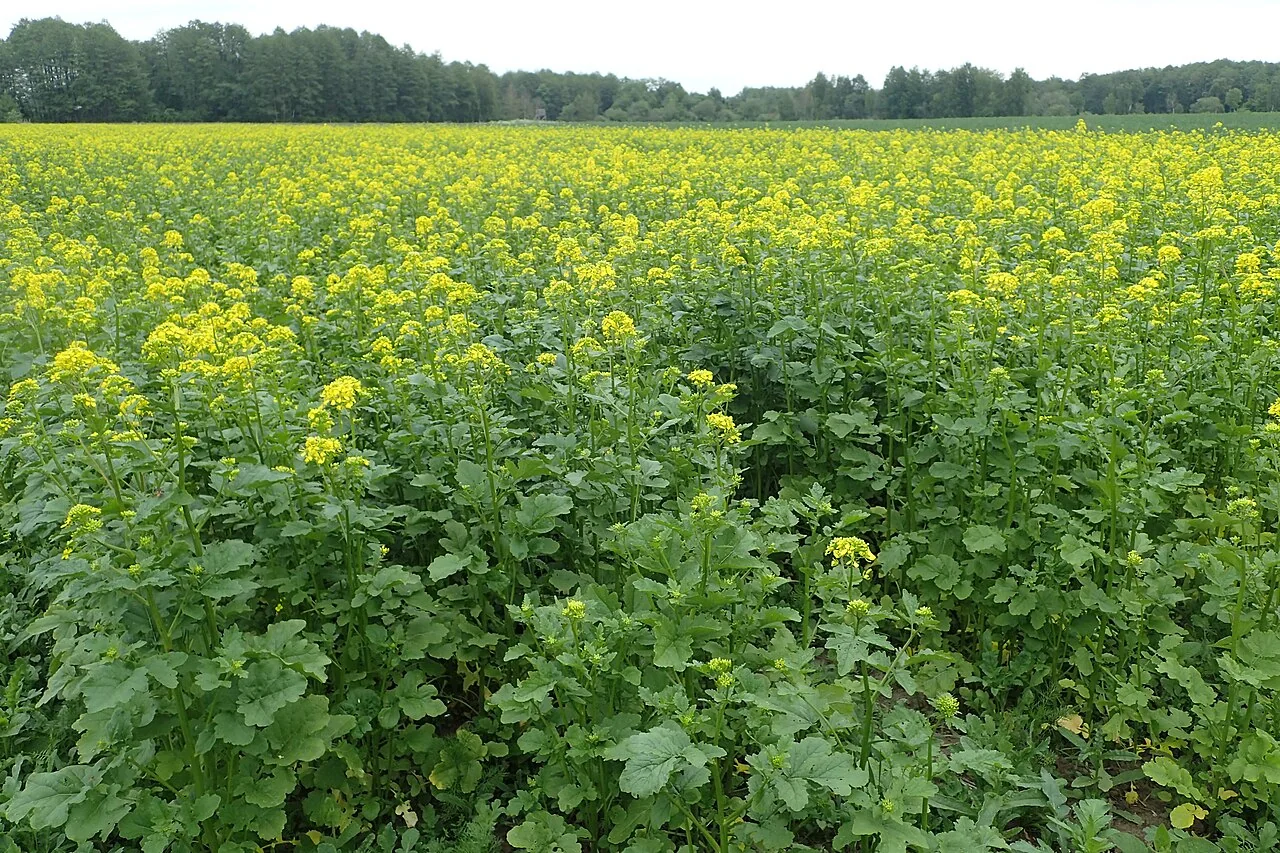
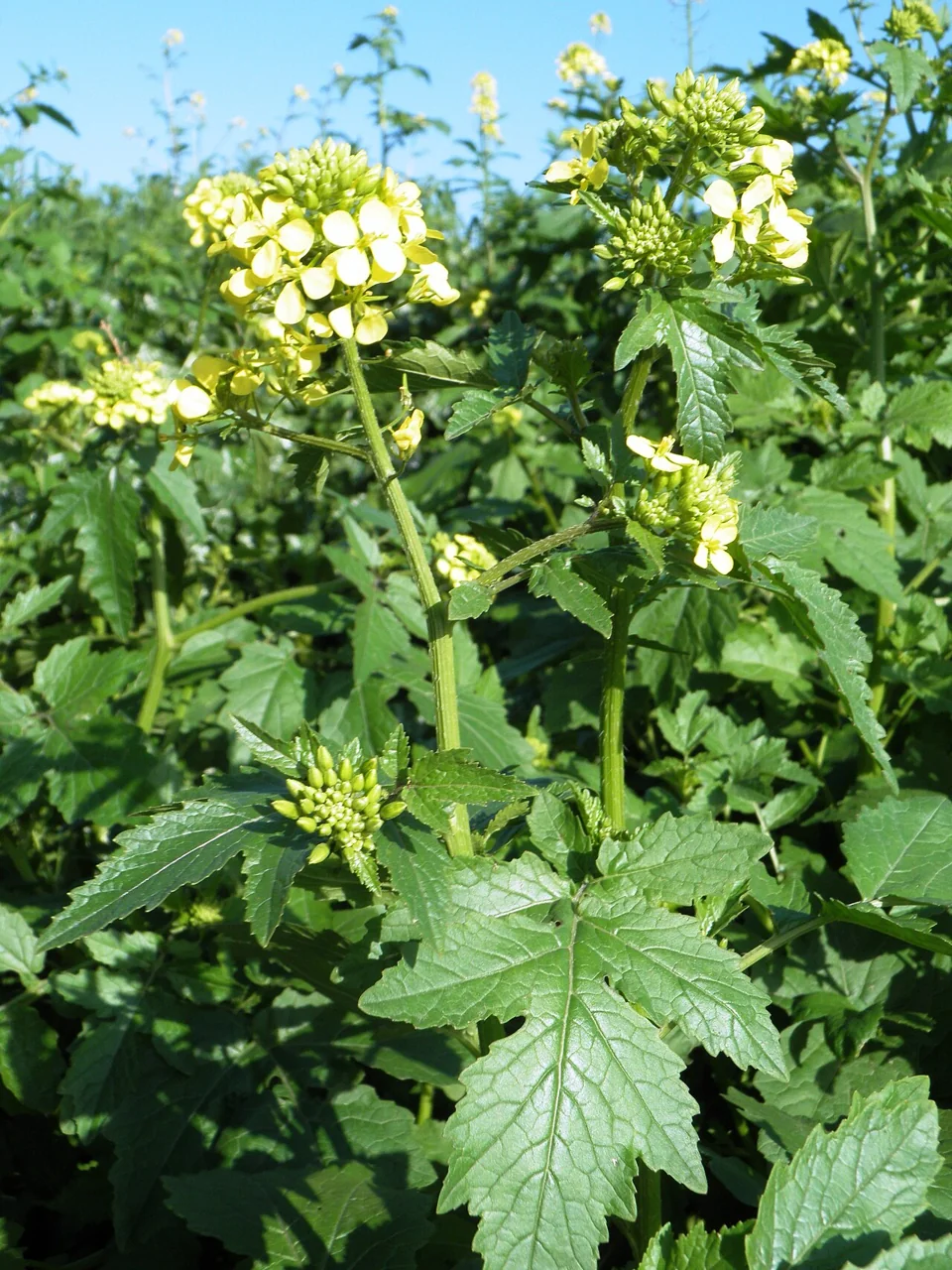
Pollinator plant

White mustard

Sinapis alba

Linked agroforestry plant data
Pollinator recipe

Common names

32 names · 27 languages
EnglishYour language
Other languages (26)
Dutch
  • Gele mosterd
  • Witte mosterd[1][3]
French
Catalan
Chinese (Simplified)
Chinese (Traditional)
Czech
  • hořčice setá[3]
Danish
  • Gul sennep[3]
Finnish
  • keltasinappi[3]
German
Greek
  • Αγριόβρουβα[3]
  • Λαψανίδα[3]
  • Σινάπι το λευκό[3]
Hebrew
  • חרדל לבן[3]
Hindi
  • सरसों[3]
Hungarian
  • fehér mustár[3]
Italian
Japanese
  • シロガラシ[3]
Lithuanian
  • Baltoji garstyčia[3]
Norwegian
  • hvitsennep[3]
Polish
  • gorczyca biała[3]
Portuguese
Russian
  • Горчица белая[3]
Slovak
  • horčica biela[3]
Slovenian
  • bela gorjušica[3]
Spanish
Swedish
Turkish
Ukrainian
  • Гірчиця біла[3]
Sources & name notes (3)

Names recorded in our plant catalogue and botanical sources, grouped by language. Usage can vary by region.

Numbered references identify names recorded by an external source. Other names are from our plant catalogue.

[1] Sinapis alba — iNaturalist taxon names ↗

Community-curated iNaturalist taxonomy. This is a common-name attestation, not an independent botanical determination.

Source records
  • White Mustard — results[0].names[1]; taxon id 79123; Sinapis alba.
  • Witte mosterd — results[0].names[22]; taxon id 79123; Sinapis alba.
  • Moutarde blanche — results[0].names[4]; taxon id 79123; Sinapis alba.
  • Weißer Senf — results[0].names[10]; taxon id 79123; Sinapis alba.
  • Mostaza blanca — results[0].names[5]; taxon id 79123; Sinapis alba.
  • Mostaza de hoja — results[0].names[14]; taxon id 79123; Sinapis alba.
  • Senape bianca — results[0].names[23]; taxon id 79123; Sinapis alba.
  • mostarda-branca — results[0].names[31]; taxon id 79123; Sinapis alba.
  • Mostardeira-branca — results[0].names[7]; taxon id 79123; Sinapis alba.
[2] Catalogue of Life 2026-08-20 — Sinapis alba ↗

Common names from World Plants, version 26.05, reproduced in Catalogue of Life 2026-08-20. License: CC BY.

Source records
  • Weißer Senf (DE); White Mustard (EN); Mostaza blanca (ES) — VernacularName.tsv, line 147138; taxon 4XJCN.
[3] Sinapis alba — iNaturalist taxon names ↗

Community-curated iNaturalist taxonomy; common-name attestation, not an independent botanical determination.

Source records
  • White Mustard — results[0].names[1]; taxon id 79123; Sinapis alba.
  • Witte mosterd — results[0].names[22]; taxon id 79123; Sinapis alba.
  • Moutarde blanche — results[0].names[4]; taxon id 79123; Sinapis alba.
  • Weißer Senf — results[0].names[10]; taxon id 79123; Sinapis alba.
  • Mostaza blanca — results[0].names[5]; taxon id 79123; Sinapis alba.
  • Mostaza de hoja — results[0].names[14]; taxon id 79123; Sinapis alba.
  • Senape bianca — results[0].names[23]; taxon id 79123; Sinapis alba.
  • mostarda-branca — results[0].names[31]; taxon id 79123; Sinapis alba.
  • Mostardeira-branca — results[0].names[7]; taxon id 79123; Sinapis alba.
  • חרדל לבן — results[0].names[3]; taxon id 79123; Sinapis alba.
  • Горчица белая — results[0].names[6]; taxon id 79123; Sinapis alba.
  • hvitsennep — results[0].names[8]; taxon id 79123; Sinapis alba.
  • keltasinappi — results[0].names[9]; taxon id 79123; Sinapis alba.
  • hořčice setá — results[0].names[11]; taxon id 79123; Sinapis alba.
  • Λαψανίδα — results[0].names[12]; taxon id 79123; Sinapis alba.
  • Baltoji garstyčia — results[0].names[13]; taxon id 79123; Sinapis alba.
  • シロガラシ — results[0].names[15]; taxon id 79123; Sinapis alba.
  • 白芥菜 — results[0].names[16]; taxon id 79123; Sinapis alba.
  • 白芥菜 — results[0].names[17]; taxon id 79123; Sinapis alba.
  • Mostassa — results[0].names[18]; taxon id 79123; Sinapis alba.
  • Σινάπι το λευκό — results[0].names[19]; taxon id 79123; Sinapis alba.
  • Αγριόβρουβα — results[0].names[20]; taxon id 79123; Sinapis alba.
  • vitsenap — results[0].names[21]; taxon id 79123; Sinapis alba.
  • Gul sennep — results[0].names[24]; taxon id 79123; Sinapis alba.
  • gorczyca biała — results[0].names[25]; taxon id 79123; Sinapis alba.
  • Гірчиця біла — results[0].names[26]; taxon id 79123; Sinapis alba.
  • fehér mustár — results[0].names[27]; taxon id 79123; Sinapis alba.
  • bela gorjušica — results[0].names[28]; taxon id 79123; Sinapis alba.
  • सरसों — results[0].names[29]; taxon id 79123; Sinapis alba.
  • Akhardal — results[0].names[30]; taxon id 79123; Sinapis alba.
  • horčica biela — results[0].names[32]; taxon id 79123; Sinapis alba.
Plant references

Source-backed information

Published observations for this plant. Each reference supports the information beside it.

Taxonomy
Sinapis alba is an accepted species in Catalogue of Life.

Taxonomic treatment in the August 2026 release; the catalogue record name is preserved.

Sources [1]
Botanical family
Brassicaceae

Family in the cited taxonomic treatment.

Sources [1]
Native range
Europe to China.

Explicit native locality records in Kew WCVP v16; introduced and doubtful distributions excluded. Continent conversion follows the documented geographic mapping.

Sources [2]
Catalogue ratings

Who this plant supports

Honey bees

High suitability
Nectar value High
Pollen value High
Agroforestry database

Complete plant information

Open full plant profile

Structure

Vegetation layer
Herbaceous
Size
Small
Dimensions
0.60 m high × 0.30 m wide
Growth rate
Slow
Lifecycle
Annual

Site conditions

USDA hardiness
5-9
Moisture
Moist
Soil
Sandy, Loamy, Clay
pH
Acid, Neutral, Alkaline
Light
Partial shade, Sun

Uses

Edible parts
Leaves, Oil, Seed, Seasoning
Functions
Nitrogen fixer, Oil
Edibility
3 out of 5
Medicinal value
3 out of 5

Leaves - can be consumed both raw and cooked. They have a spicy flavor, especially when eaten raw. Young leaves are often used as a flavor enhancer in salads, while older leaves serve as a vegetable. Seeds - can be eaten raw after they have germinated for about 4 days. They have a spicy taste and are often added to salads. The seeds can be ground into a powder and used as a flavor enhancer, known commercially as 'yellow mustard.' This type of mustard is milder than black mustard from Brassica nigra. The heat of the mustard develops when cold water is added to the ground seeds - an enzyme (myrosin) reacts with a glycoside (sinigrin) to produce a sulfur compound. This reaction lasts about 10-15 minutes. Mustard can be mixed with hot water or vinegar, or salt can be added.

Sources and references

References for the information marked with source numbers on this page.

Sources checked
  1. Catalogue of Life Sinapis alba — Catalogue of Life COL26.8

    COL26.8 (2026-08-20). Contributing checklist: Synonymic Checklists of the Vascular Plants of the World. This is taxonomic evidence, not an independent ecological study.

    Supports: TaxonomyBotanical family
    Relevant sections
    • Taxonomy: NameUsage.tsv line 1224275; ID 4XJCN; rank species; status accepted
    • Botanical family: NameUsage.tsv line 1224275; ID 4XJCN; rank species; status accepted

    Source checked on .

    Source data licence: CC BY 4.0.

  2. Royal Botanic Gardens, Kew Sinapis alba — Kew WCVP native distribution

    Native distribution and taxonomic treatment from the official WCVP v16 export (4 June 2026). The link opens the corresponding POWO taxon. Source rows are retained in the native-range audit archive.

    Supports: Native range
    Relevant sections
    • Native range: WCVP v16; wcvp_names.csv lines 207274; wcvp_distribution.csv native locality lines 936975, 936981, 936982, 936983, 936984, 936987, 936988, 936990, 936991, 936992, 936993, 936994, 936995, 936996, 936997, 936998, 936999, 937000, 937001, 937002, 937003, 937004, 937005, 937006, 937007, 937008, 937009, 937010, 937012, 937013, 937014, 937015, 937017, 937018, 937019, 937025, 937029, 937030, 937031, 937035, 937037, 937038, 937039, 937040, 937041, 937042, 937043, 937044, 937045, 937046, 937047, 937048, 937049, 937050, 937051, 937052, 937053, 937054, 937057, 937058, 937059

    Source checked on .

    Source data licence: CC BY 3.0.