Sweet cherry
Prunus avium
Linked agroforestry plant dataPlant photos
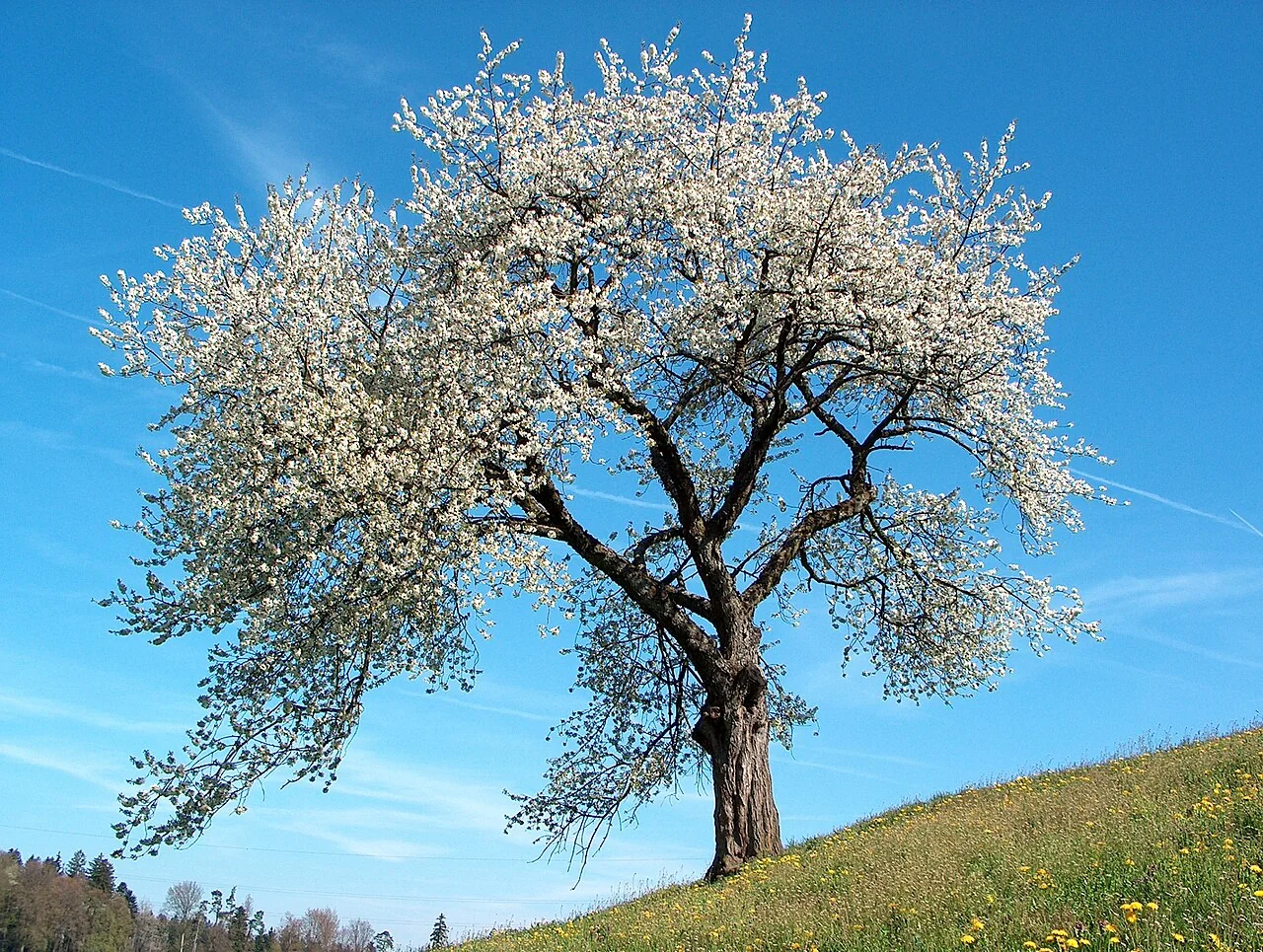
2 photos · Select to enlarge
A sweet cherry tree in spring blossom.
Benjamin Gimmel, BenHur / Wikimedia Commons / CC BY-SA 3.0
Photo details
Resized and converted to WebP. No content edits.
Source: File:Frühling blühender Kirschenbaum.jpg
Reviewed . Source identification and visible plant parts reviewed against this plant record.
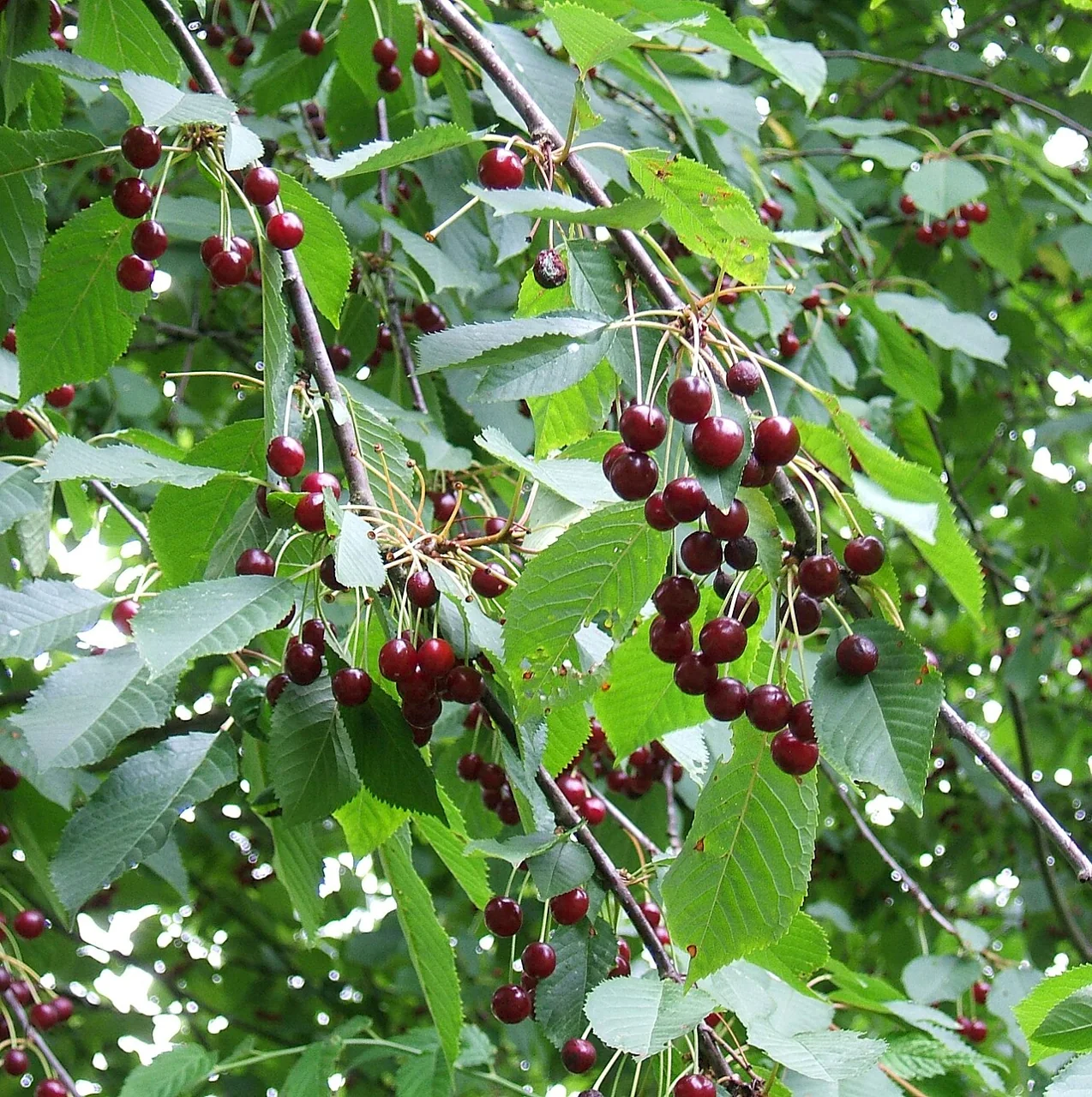
Cherries ripening on a leafy branch.
MPF / Wikimedia Commons / CC BY 2.5
Photo details
Resized and converted to WebP. No content edits.
Source: File:Prunus avium fruit.jpg
Reviewed . Source identification and visible plant parts reviewed against this plant record.
Common names
48 names · 33 languagesOther languages (32)
- Basque
-
- Gereziondoa[4]
- Belarusian
-
- Чарэшня[4]
- Chinese (Traditional)
-
- 歐洲甜櫻桃[4]
- Croatian
-
- Divlja trešnja[4]
- Danish
-
- Fugle-kirsebær[4]
- Estonian
-
- magus kirsipuu[4]
- Finnish
-
- imeläkirsikka[4]
- Galician
-
- Cerdeira[4]
- Hebrew
-
- דובדבן מתוק[4]
- Korean
-
- 양벚나무[4]
- Lithuanian
-
- Paprastoji trešnė[4]
- Norwegian
-
- morell[4]
- Polish
-
- Wiśnia ptasia[4]
- Romanian
-
- Cireș[4]
- Russian
-
- Черешня[4]
- Slovak
-
- čerešňa vtáčia[4]
- Slovenian
-
- češnja[4]
- Swedish
-
- Sötkörsbär[4]
- Turkish
-
- kiraz[4]
- Ukrainian
-
- Черешня[4]
Sources & name notes (6)
Names recorded in our plant catalogue and botanical sources, grouped by language. Usage can vary by region.
Catalogue language labels are reviewed separately from botanical source records.
Numbered references identify names recorded by an external source. Other names are from our plant catalogue.
NC State Extension Gardener Plant Toolbox; English common names in a United States horticultural reference.
Source records
- Sweet Cherry — ul#common_names > li:nth-of-type(1); heading: Common Name(s):; Prunus avium.
Community-curated iNaturalist taxonomy. This is a common-name attestation, not an independent botanical determination.
Source records
- sweet cherry — results[0].names[2]; taxon id 61964; Prunus avium.
- Zoete kers — results[0].names[15]; taxon id 61964; Prunus avium.
- wild cherry — results[0].names[1]; taxon id 61964; Prunus avium.
- Vogelkirsche — results[0].names[45]; taxon id 61964; Prunus avium.
- bird cherry — results[0].names[32]; taxon id 61964; Prunus avium.
- Gean — results[0].names[4]; taxon id 61964; Prunus avium.
- Mazzard — results[0].names[3]; taxon id 61964; Prunus avium.
- cerezo silvestre — results[0].names[28]; taxon id 61964; Prunus avium.
- Cerisier des oiseaux — results[0].names[43]; taxon id 61964; Prunus avium.
- merisier — results[0].names[10]; taxon id 61964; Prunus avium.
- ciliegio — results[0].names[9]; taxon id 61964; Prunus avium.
- cerejeira — results[0].names[5]; taxon id 61964; Prunus avium.
- cerejeira-brava — results[0].names[6]; taxon id 61964; Prunus avium.
Common names from World Plants, version 26.05, reproduced in Catalogue of Life 2026-08-20. License: CC BY.
Source records
- Sweet cherry (EN) — VernacularName.tsv, line 168389; taxon 4N8P4.
- Vogelkirsche (DE) — VernacularName.tsv, line 168391; taxon 4N8P4.
- Süßkirsche — VernacularName.tsv, line 168390; taxon 4N8P4.
Community-curated iNaturalist taxonomy; common-name attestation, not an independent botanical determination.
Source records
- sweet cherry — results[0].names[2]; taxon id 61964; Prunus avium.
- Zoete kers — results[0].names[15]; taxon id 61964; Prunus avium.
- wild cherry — results[0].names[1]; taxon id 61964; Prunus avium.
- Vogelkirsche — results[0].names[45]; taxon id 61964; Prunus avium.
- bird cherry — results[0].names[32]; taxon id 61964; Prunus avium.
- Gean — results[0].names[4]; taxon id 61964; Prunus avium.
- Mazzard — results[0].names[3]; taxon id 61964; Prunus avium.
- cerezo silvestre — results[0].names[28]; taxon id 61964; Prunus avium.
- Cerisier des oiseaux — results[0].names[43]; taxon id 61964; Prunus avium.
- merisier — results[0].names[10]; taxon id 61964; Prunus avium.
- ciliegio — results[0].names[9]; taxon id 61964; Prunus avium.
- cerejeira — results[0].names[5]; taxon id 61964; Prunus avium.
- cerejeira-brava — results[0].names[6]; taxon id 61964; Prunus avium.
- cirerer — results[0].names[7]; taxon id 61964; Prunus avium.
- cirer — results[0].names[8]; taxon id 61964; Prunus avium.
- Wiśnia ptasia — results[0].names[11]; taxon id 61964; Prunus avium.
- třešeň obecná — results[0].names[12]; taxon id 61964; Prunus avium.
- Sötkörsbär — results[0].names[13]; taxon id 61964; Prunus avium.
- Fugle-kirsebær — results[0].names[14]; taxon id 61964; Prunus avium.
- Черешня — results[0].names[16]; taxon id 61964; Prunus avium.
- magus kirsipuu — results[0].names[17]; taxon id 61964; Prunus avium.
- דובדבן מתוק — results[0].names[18]; taxon id 61964; Prunus avium.
- třešeň ptačí — results[0].names[19]; taxon id 61964; Prunus avium.
- Cerezal — results[0].names[20]; taxon id 61964; Prunus avium.
- morell — results[0].names[21]; taxon id 61964; Prunus avium.
- imeläkirsikka — results[0].names[22]; taxon id 61964; Prunus avium.
- zreizal — results[0].names[23]; taxon id 61964; Prunus avium.
- Paprastoji trešnė — results[0].names[24]; taxon id 61964; Prunus avium.
- čerešňa vtáčia — results[0].names[25]; taxon id 61964; Prunus avium.
- セイヨウミザクラ — results[0].names[26]; taxon id 61964; Prunus avium.
- オウトウ — results[0].names[27]; taxon id 61964; Prunus avium.
- 欧洲甜樱桃 — results[0].names[29]; taxon id 61964; Prunus avium.
- 歐洲甜櫻桃 — results[0].names[30]; taxon id 61964; Prunus avium.
- kiraz — results[0].names[31]; taxon id 61964; Prunus avium.
- Cireș — results[0].names[33]; taxon id 61964; Prunus avium.
- Черешня — results[0].names[34]; taxon id 61964; Prunus avium.
- Чарэшня — results[0].names[35]; taxon id 61964; Prunus avium.
- 양벚나무 — results[0].names[36]; taxon id 61964; Prunus avium.
- češnja — results[0].names[37]; taxon id 61964; Prunus avium.
- Vadcseresznye — results[0].names[38]; taxon id 61964; Prunus avium.
- 西洋实樱 — results[0].names[39]; taxon id 61964; Prunus avium.
- Divlja trešnja — results[0].names[40]; taxon id 61964; Prunus avium.
- Cerdeira — results[0].names[41]; taxon id 61964; Prunus avium.
- madárcseresznye — results[0].names[42]; taxon id 61964; Prunus avium.
- Gereziondoa — results[0].names[44]; taxon id 61964; Prunus avium.
Names retained from the referenced botanical profile or table.
Source records
- wild cherry — Page 2, column 1, row top 247 pt; common-name cell after Prunus avium.; Prunus avium.
- gean — Page 2, column 1, row top 247 pt; common-name cell after Prunus avium.; Prunus avium.
Names retained from the referenced botanical profile or table.
Source records
- wild cherry — Page 2, column 2, row top 487 pt; common-name cell after Prunus avium.; Prunus avium.
- gean — Page 2, column 2, row top 487 pt; common-name cell after Prunus avium.; Prunus avium.
Source-backed information
Published observations for this plant. Each reference supports the information beside it.
- Taxonomy
-
Prunus avium is an accepted species in Catalogue of Life.
Taxonomic treatment in the August 2026 release; the catalogue record name is preserved.
Sources [1] - Botanical family
-
Rosaceae
Family in the cited taxonomic treatment.
Sources [1] - Plant habit
-
Columnar; Conical
NC State Extension profile.
Sources [2] - Foliage
-
Deciduous
NC State Extension profile.
Sources [2] - Light
-
Full sun (6 or more hours of direct sunlight a day)
NC State Extension profile.
Sources [2] - Flowering season
-
Spring
NC State Extension profile. Seasons reflect the source region and do not verify the catalogue’s exact flowering months.
Sources [2] - Native range
-
Europe to Afghanistan, Northern Africa
NC State Extension profile. Origin reported by the source; this is not a claim of local nativeness.
Sources [2] - Reported wildlife attraction
-
Listed as attracting: butterflies, pollinators.
NC State Extension profile. Broad wildlife categories; this does not establish flower visits by a named bee species or quantify nectar and pollen.
Sources [2]
Who this plant supports
Complete plant information
Structure
- Vegetation layer
- Fruit tree
- Size
- Large
- Dimensions
- 18.00 m high × 7.00 m wide
- Growth rate
- Fast
- Lifecycle
- Perennial
- Foliage
- Deciduous
Site conditions
- USDA hardiness
- 3-7
- Moisture
- Moist
- Soil
- Sandy, Loamy, Clay
- pH
- Acid, Neutral, Alkaline
- Light
- Partial shade, Sun
Uses
- Edible parts
- Fruit, Seed
- Functions
- Dye, Gum, Timber, Pollinator plant
- Edibility
- 4 out of 5
- Medicinal value
- 2 out of 5
The fruit, both raw and cooked, can be sweet or bitter, but never sour. It is used in dishes such as pies and jams because of its sweet taste. The fruit consists of about 78% water and contains 8.5-14% sugars. With a diameter of about 20 mm, the fruit contains a large seed. Be careful not to eat the seed if it is too bitter, as it can then be toxic. An edible gum can be obtained by processing the bark.
Sources and references
References for the information marked with source numbers on this page.
-
Catalogue of Life
Prunus avium — Catalogue of Life COL26.8
COL26.8 (2026-08-20). Contributing checklist: Synonymic Checklists of the Vascular Plants of the World. This is taxonomic evidence, not an independent ecological study.
Relevant sections
- Taxonomy: NameUsage.tsv line 1041500; ID 4N8P4; rank species; status accepted
- Botanical family: NameUsage.tsv line 1041500; ID 4N8P4; rank species; status accepted
Source checked on .
Source data licence: CC BY 4.0.
-
NC State Extension
Prunus avium — Plant Toolbox
NC State Extension Gardener Plant Toolbox. Growing conditions and seasons reflect its United States horticultural context.
Relevant sections
- Plant habit: Habit/Form
- Foliage: Woody Plant Leaf Characteristics
- Light: Light
- Flowering season: Flower Bloom Time
- Native range: Country Or Region Of Origin
- Reported wildlife attraction: Attracts
Source checked on .
-
Royal Horticultural Society
RHS Plants for Pollinators — Wildflowers
RHS planting guidance; applicable flower-form restrictions are retained. General recommendations do not measure local nectar or pollen production.
Supports: Pollinator guidanceRelevant sections
- Pollinator guidance: Page 2, column 2, entry Prunus avium (top 487 pt)
Source checked on .
-
Royal Horticultural Society
RHS Plants for Pollinators — Plants Of The World
RHS planting guidance; applicable flower-form restrictions are retained. General recommendations do not measure local nectar or pollen production.
Supports: Pollinator guidanceRelevant sections
- Pollinator guidance: Page 2, column 1, entry Prunus avium (top 247 pt)
Source checked on .