Pollinator plant

Chinese hawthorn

Crataegus pinnatifida

Linked agroforestry plant data
Pollinator recipe

Common names

24 names · 14 languages
EnglishYour language
+3 more namesShow fewer names
  • Hawthorne[1]
  • Mountain Hawthorn[1]
  • Thornapple[1]
Other languages (13)
Dutch
  • Chinese meidoorn
  • Meidoorn
French
  • Aubépine de Chine
Chinese (Simplified)
Chinese (Traditional)
Czech
  • hloh peřenoklaný[3]
Estonian
  • sulghõlmine viirpuu[3]
  • sulglõhine viirpuu[3]
Finnish
  • välkeorapihlaja[3]
Japanese
  • オオサンザシ[3]
  • 大実山査子[3]
Korean
  • 산사나무[3]
Persian
  • زالزالک چینی، زالزالک شانه ای[3]
Russian
  • Боярышник перистонадрезанный[3]
  • Боярышник перистораздельный[3]
Slovak
  • hloh perovitodelený[3]
Swedish
  • kinesisk hagtorn[3]
Sources & name notes (3)

Names recorded in our plant catalogue and botanical sources, grouped by language. Usage can vary by region.

Numbered references identify names recorded by an external source. Other names are from our plant catalogue.

[1] Crataegus pinnatifida — Plant Toolbox common names ↗

NC State Extension Gardener Plant Toolbox; English common names in a United States horticultural reference.

Source records
  • Chinese Hawthorn — ul#common_names > li:nth-of-type(2); heading: Common Name(s):; Crataegus pinnatifida.
  • Chinese Hawberry — ul#common_names > li:nth-of-type(1); heading: Common Name(s):; Crataegus pinnatifida.
  • Hawthorn — ul#common_names > li:nth-of-type(3); heading: Common Name(s):; Crataegus pinnatifida.
  • Hawthorne — ul#common_names > li:nth-of-type(4); heading: Common Name(s):; Crataegus pinnatifida.
  • Mountain Hawthorn — ul#common_names > li:nth-of-type(5); heading: Common Name(s):; Crataegus pinnatifida.
  • Thornapple — ul#common_names > li:nth-of-type(6); heading: Common Name(s):; Crataegus pinnatifida.
[2] Crataegus pinnatifida — iNaturalist taxon names ↗

Community-curated iNaturalist taxonomy. This is a common-name attestation, not an independent botanical determination.

Source records
  • Chinese hawthorn — results[0].names[9]; taxon id 475319; Crataegus pinnatifida.
[3] Crataegus pinnatifida — iNaturalist taxon names ↗

Community-curated iNaturalist taxonomy; common-name attestation, not an independent botanical determination.

Source records
  • Chinese hawthorn — results[0].names[9]; taxon id 475319; Crataegus pinnatifida.
  • 산사나무 — results[0].names[1]; taxon id 475319; Crataegus pinnatifida.
  • sulglõhine viirpuu — results[0].names[2]; taxon id 475319; Crataegus pinnatifida.
  • sulghõlmine viirpuu — results[0].names[3]; taxon id 475319; Crataegus pinnatifida.
  • hloh peřenoklaný — results[0].names[4]; taxon id 475319; Crataegus pinnatifida.
  • オオサンザシ — results[0].names[5]; taxon id 475319; Crataegus pinnatifida.
  • kinesisk hagtorn — results[0].names[6]; taxon id 475319; Crataegus pinnatifida.
  • 山楂 — results[0].names[7]; taxon id 475319; Crataegus pinnatifida.
  • Боярышник перистонадрезанный — results[0].names[8]; taxon id 475319; Crataegus pinnatifida.
  • 山楂 — results[0].names[10]; taxon id 475319; Crataegus pinnatifida.
  • 羽裂山楂 — results[0].names[11]; taxon id 475319; Crataegus pinnatifida.
  • 大実山査子 — results[0].names[12]; taxon id 475319; Crataegus pinnatifida.
  • välkeorapihlaja — results[0].names[13]; taxon id 475319; Crataegus pinnatifida.
  • زالزالک چینی، زالزالک شانه ای — results[0].names[14]; taxon id 475319; Crataegus pinnatifida.
  • hloh perovitodelený — results[0].names[15]; taxon id 475319; Crataegus pinnatifida.
  • Боярышник перистораздельный — results[0].names[16]; taxon id 475319; Crataegus pinnatifida.
Plant references

Source-backed information

Published observations for this plant. Each reference supports the information beside it.

Taxonomy
Crataegus pinnatifida is an accepted species in Catalogue of Life.

Taxonomic treatment in the August 2026 release; the catalogue record name is preserved.

Sources [1]
Botanical family
Rosaceae

Family in the cited taxonomic treatment.

Sources [1]
Mature height
4.57–7.01 m

NC State Extension profile. Converted from the source range in feet and inches; mature size varies with growing conditions.

Sources [2]
Mature spread
3.05–7.01 m

NC State Extension profile. Converted from the source range in feet and inches; mature size varies with growing conditions.

Sources [2]
Plant habit
Erect; Open

NC State Extension profile.

Sources [2]
Life cycle
Perennial

NC State Extension profile.

Sources [2]
Growth rate
Medium

NC State Extension profile.

Sources [2]
Foliage
Deciduous

NC State Extension profile.

Sources [2]
Light
Full sun (6 or more hours of direct sunlight a day); Partial Shade (Direct sunlight only part of the day, 2-6 hours)

NC State Extension profile.

Sources [2]
Moisture and drainage
Good Drainage; Moist

NC State Extension profile.

Sources [2]
Soil texture
Clay; Loam (Silt); Sand

NC State Extension profile.

Sources [2]
Soil pH
Acid (<6.0); Alkaline (>8.0); Neutral (6.0-8.0)

NC State Extension profile. These source categories do not certify the catalogue’s numeric pH interval.

Sources [2]
Flowering season
Spring

NC State Extension profile. Seasons reflect the source region and do not verify the catalogue’s exact flowering months.

Sources [2]
Reported wildlife attraction
Listed as attracting: butterflies, pollinators.

NC State Extension profile. Broad wildlife categories; this does not establish flower visits by a named bee species or quantify nectar and pollen.

Sources [2]
Native range
Russian Far East to N. & E. China.

Explicit native locality records in Kew WCVP v16; introduced and doubtful distributions excluded. Continent conversion follows the documented geographic mapping.

Sources [3]
Catalogue ratings

Who this plant supports

Honey bees

Low suitability
Nectar value Low
Pollen value Low
Agroforestry database

Complete plant information

Open full plant profile

Structure

Vegetation layer
Fruit tree, Shrub
Size
S,M
Dimensions
7.00 m high × 7.00 m wide
Growth rate
Moderate
Lifecycle
Perennial
Foliage
Deciduous

Site conditions

USDA hardiness
5-9
Moisture
Moist, Wet
Soil
Sandy, Loamy, Clay
pH
Acid, Neutral, Alkaline
Light
Partial shade, Sun

Uses

Edible parts
Fruit, Leaves, Flowers
Functions
Timber, Voedselbos, Fragrant
Edibility
3 out of 5
Medicinal value
3 out of 5

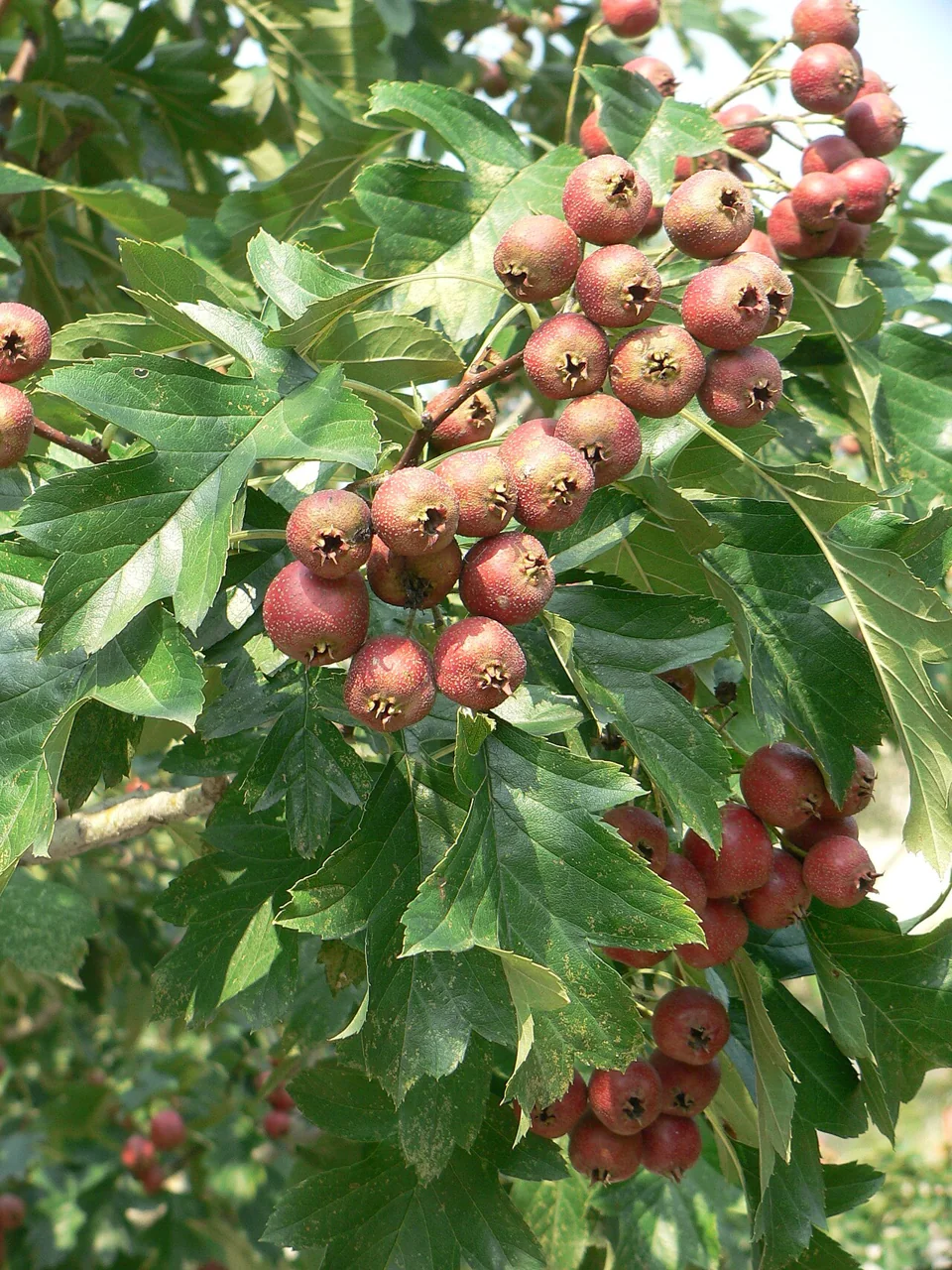
Fruit - can be consumed raw or cooked. The orange fruit has a powdery texture, a sour taste, and a slight bitterness, but is quite pleasant when eaten raw. This fruit ripens quite late; specimens observed towards the end of October 1998 were not yet fully ripe. The fruit can be used in pies, preserves, and can also be dried for long-term storage. The fruit typically has a diameter of about 15 mm, although in some cases the diameter can reach 25 mm. A nutritional analysis is available. In the center of the fruit, there can be up to five fairly large seeds, which often stick together, making eating them reminiscent of a cherry-like fruit with a single seed.

Sources and references

References for the information marked with source numbers on this page.

Sources checked
  1. Catalogue of Life Crataegus pinnatifida — Catalogue of Life COL26.8

    COL26.8 (2026-08-20). Contributing checklist: Synonymic Checklists of the Vascular Plants of the World. This is taxonomic evidence, not an independent ecological study.

    Supports: TaxonomyBotanical family
    Relevant sections
    • Taxonomy: NameUsage.tsv line 5398620; ID Z8BB; rank species; status accepted
    • Botanical family: NameUsage.tsv line 5398620; ID Z8BB; rank species; status accepted

    Source checked on .

    Source data licence: CC BY 4.0.

  2. NC State Extension Crataegus pinnatifida — Plant Toolbox

    NC State Extension Gardener Plant Toolbox. Growing conditions and seasons reflect its United States horticultural context.

    Relevant sections
    • Mature height: Dimensions / Height
    • Mature spread: Dimensions / Width
    • Plant habit: Habit/Form
    • Life cycle: Life Cycle
    • Growth rate: Growth Rate
    • Foliage: Woody Plant Leaf Characteristics
    • Light: Light
    • Moisture and drainage: Soil Drainage
    • Soil texture: Soil Texture
    • Soil pH: Soil pH
    • Flowering season: Flower Bloom Time
    • Reported wildlife attraction: Attracts

    Source checked on .

  3. Royal Botanic Gardens, Kew Crataegus pinnatifida — Kew WCVP native distribution

    Native distribution and taxonomic treatment from the official WCVP v16 export (4 June 2026). The link opens the corresponding POWO taxon. Source rows are retained in the native-range audit archive.

    Supports: Native range
    Relevant sections
    • Native range: WCVP v16; wcvp_names.csv lines 924255; wcvp_distribution.csv native locality lines 1857306, 1857307, 1857308, 1857309, 1857310, 1857311, 1857312, 1857313

    Source checked on .

    Source data licence: CC BY 3.0.