Sagittaria latifolia
Duck Potato, Broadleaf Arrowhead
Explore the size, hardiness, soil, light, edible uses and harvest period of Sagittaria latifolia.
Plant photos
2 photos · Select to enlarge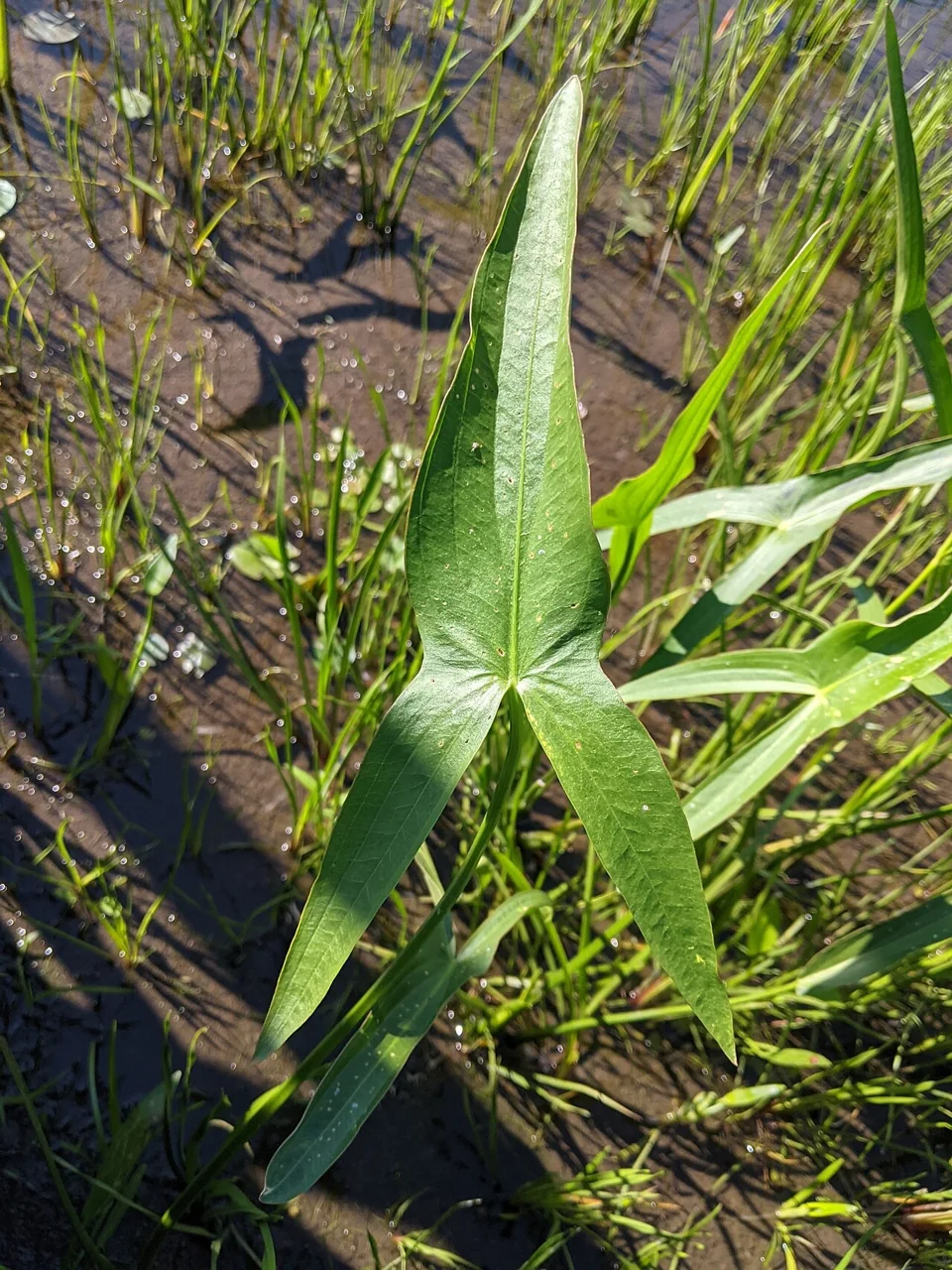
Leaves of Sagittaria latifolia.
Benoit Renaud / Wikimedia Commons / CC BY 4.0
.jpeg)
Photo details
Resized and converted to WebP. No content edits.
Source: File:Sagittaria latifolia leaf (05).jpeg
Reviewed . Source identification, photograph and license reviewed. The image illustrates the named plant; it does not verify dimensions or other plant traits.
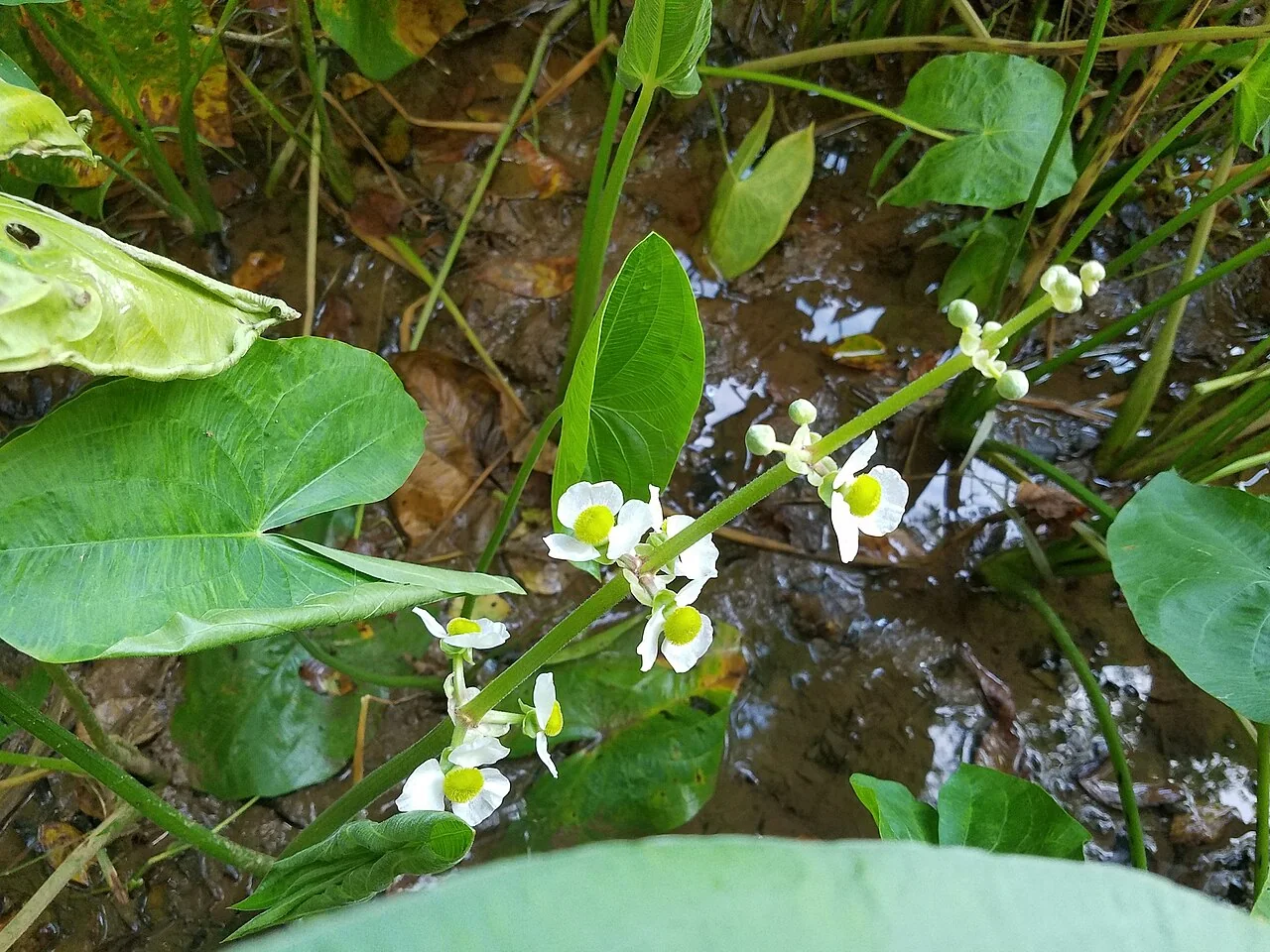
Flowers of Sagittaria latifolia.
Leila Dasher / Wikimedia Commons / CC BY 4.0
.jpg)
Photo details
Resized and converted to WebP. No content edits.
Source: File:Sagittaria latifolia flower (08).jpg
Reviewed . Source identification, photograph and license reviewed. The image illustrates the named plant; it does not verify dimensions or other plant traits.
Common names
30 names · 24 languagesOther languages (23)
- Dutch
-
- Breed pijlkruid[1]
- Breedbladig Pijlkruid
- French
-
- Sagittaire à larges feuilles[1]
- Chinese (Simplified)
-
- 弯喙慈姑[1]
- Chinese (Traditional)
-
- 彎喙慈姑[1]
- Czech
-
- šípatka širolistá[1]
- Downriver Halkomelem
-
- x̌ʷc̓əq̓ʷə́wl̓s[1]
- Finnish
-
- amerikankeiholehti[1]
- German
-
- Breitblättriges Pfeilkraut[1]
- Hungarian
-
- széleslevelű nyílfű[1]
- Island Halkomelem
-
- sqewth[1]
- Italian
-
- Sagittaria americana[1]
- Ojibwe
-
- Wapato, Waabiziipin,Ajijaakokaad[1]
- Polish
-
- strzałka szerokolistna[1]
- Portuguese
-
- Batata-de-índio[1]
- Russian
-
- Стрелолист широколистный[1]
- Secwepemc
-
- skwenkwínem[1]
- Slovak
-
- šípovka širokolistá[1]
- Slovenian
-
- širokolistna streluša[1]
- Spanish
-
- Bayoneta[1]
- Squamish
-
- wápatu[1]
- Swedish
-
- bredpilblad[1]
- Ukrainian
-
- Стрілолист широколистий[1]
- Upriver Halkomelem
-
- sqewth[1]
Sources & name notes (1)
Names recorded in our plant catalogue and botanical sources, grouped by language. Usage can vary by region.
Numbered references identify names recorded by an external source. Other names are from our plant catalogue.
Community-curated iNaturalist taxonomy; common-name attestation, not an independent botanical determination.
Source records
- broadleaf arrowhead — results[0].names[1]; taxon id 48070; Sagittaria latifolia.
- wapato — results[0].names[2]; taxon id 48070; Sagittaria latifolia.
- duck-potato — results[0].names[3]; taxon id 48070; Sagittaria latifolia.
- Bayoneta — results[0].names[4]; taxon id 48070; Sagittaria latifolia.
- common arrowhead — results[0].names[5]; taxon id 48070; Sagittaria latifolia.
- broad-leaved arrowhead — results[0].names[7]; taxon id 48070; Sagittaria latifolia.
- Sagittaria americana — results[0].names[8]; taxon id 48070; Sagittaria latifolia.
- Sagittaire à larges feuilles — results[0].names[9]; taxon id 48070; Sagittaria latifolia.
- Batata-de-índio — results[0].names[10]; taxon id 48070; Sagittaria latifolia.
- šípatka širolistá — results[0].names[11]; taxon id 48070; Sagittaria latifolia.
- Breed pijlkruid — results[0].names[12]; taxon id 48070; Sagittaria latifolia.
- Breitblättriges Pfeilkraut — results[0].names[13]; taxon id 48070; Sagittaria latifolia.
- Стрелолист широколистный — results[0].names[14]; taxon id 48070; Sagittaria latifolia.
- 弯喙慈姑 — results[0].names[15]; taxon id 48070; Sagittaria latifolia.
- 彎喙慈姑 — results[0].names[16]; taxon id 48070; Sagittaria latifolia.
- bredpilblad — results[0].names[17]; taxon id 48070; Sagittaria latifolia.
- Wapato, Waabiziipin,Ajijaakokaad — results[0].names[18]; taxon id 48070; Sagittaria latifolia.
- strzałka szerokolistna — results[0].names[19]; taxon id 48070; Sagittaria latifolia.
- széleslevelű nyílfű — results[0].names[20]; taxon id 48070; Sagittaria latifolia.
- amerikankeiholehti — results[0].names[21]; taxon id 48070; Sagittaria latifolia.
- širokolistna streluša — results[0].names[22]; taxon id 48070; Sagittaria latifolia.
- šípovka širokolistá — results[0].names[23]; taxon id 48070; Sagittaria latifolia.
- wápatu — results[0].names[24]; taxon id 48070; Sagittaria latifolia.
- x̌ʷc̓əq̓ʷə́wl̓s — results[0].names[25]; taxon id 48070; Sagittaria latifolia.
- sqewth — results[0].names[26]; taxon id 48070; Sagittaria latifolia.
- sqewth — results[0].names[27]; taxon id 48070; Sagittaria latifolia.
- skwenkwínem — results[0].names[28]; taxon id 48070; Sagittaria latifolia.
- Стрілолист широколистий — results[0].names[29]; taxon id 48070; Sagittaria latifolia.
General information
Kew's family placement for the genus Sagittaria (WCVP v16).
Sources [1]Plant characteristics
NC State landscape size range; converted from feet and inches. Size varies with site, age and management.
Sources [3]NC State landscape size range; converted from feet and inches. Size varies with site, age and management.
Sources [3]Growing conditions
USDA zones listed by NC State; winter survival does not establish reliable cropping.
Sources [3]Frequent Standing Water, Moist, Occasionally Wet
Moisture and drainage conditions listed by NC State.
Sources [3]Acidic Neutral Alkaline
Uses
Root
None
Description
The root can be eaten both raw and cooked. When roasted, it takes on a texture similar to that of potatoes and a flavor reminiscent of chestnuts. The tubers are edible when raw, but the skin can be quite bitter. It is best to peel the skin after the tubers have been cooked. Additionally, the tubers can be dried and ground into a powder, which can be used as porridge or mixed with grain flour to make bread. Native Americans in North America sliced the cooked roots into thin pieces and dried them in the same way as apples, by threading them onto strings. The egg-shaped tubers are 4-5 cm long and grow at the end of slender roots, usually about 30 cm deep in the ground and a short distance from the parent plant. The tubers are best harvested in late summer when the leaves are dying back.
Harvest
Sources and references
References for the information marked with source numbers on this page.
-
Royal Botanic Gardens, Kew
World Checklist of Vascular Plants, version 16, extracted 4 June 2026
Relevant sections
- Botanical family: WCVP v16, wcvp_names.csv row 1165563; name ID 287722; Sagittaria Ruppius ex L.. Family column.
- Taxonomy: WCVP v16, wcvp_names.csv row 1164746; name ID 287247; Sagittaria latifolia Willd..
Source checked on .
Source data licence: CC BY 3.0.
-
Catalogue of Life
Catalogue of Life 2026-08-20 — Sagittaria latifolia
Taxonomic data from WCVP, version 16.0, reproduced in Catalogue of Life 2026-08-20. This shares the Kew WCVP evidence base cited on this page.
Supports: TaxonomyRelevant sections
- Taxonomy: COL 2026-08-20, NameUsage.tsv line 1169221, ID 4TYQL: Sagittaria latifolia Willd. (accepted).
Source checked on .
-
NC State Extension, North Carolina State University
Sagittaria latifolia — Extension Gardener Plant Toolbox
Relevant sections
- Height: Dimensions > Height; Height: 2 ft. 0 in. - 2 ft. 8 in.
- Spread: Dimensions > Width; Width: 2 ft. 0 in. - 2 ft. 8 in.
- Foliage: Woody Plant Leaf Characteristics
- Growth habit: Habit/Form
- Life cycle: Life Cycle
- Light: Light
- Soil moisture: Soil Drainage
- Soil texture: Soil Texture
- USDA hardiness: USDA Plant Hardiness Zone
Source checked on .