Quercus ilex
Holly Oak
Explore the size, hardiness, soil, light, edible uses and harvest period of Quercus ilex.
Plant photos
2 photos · Select to enlarge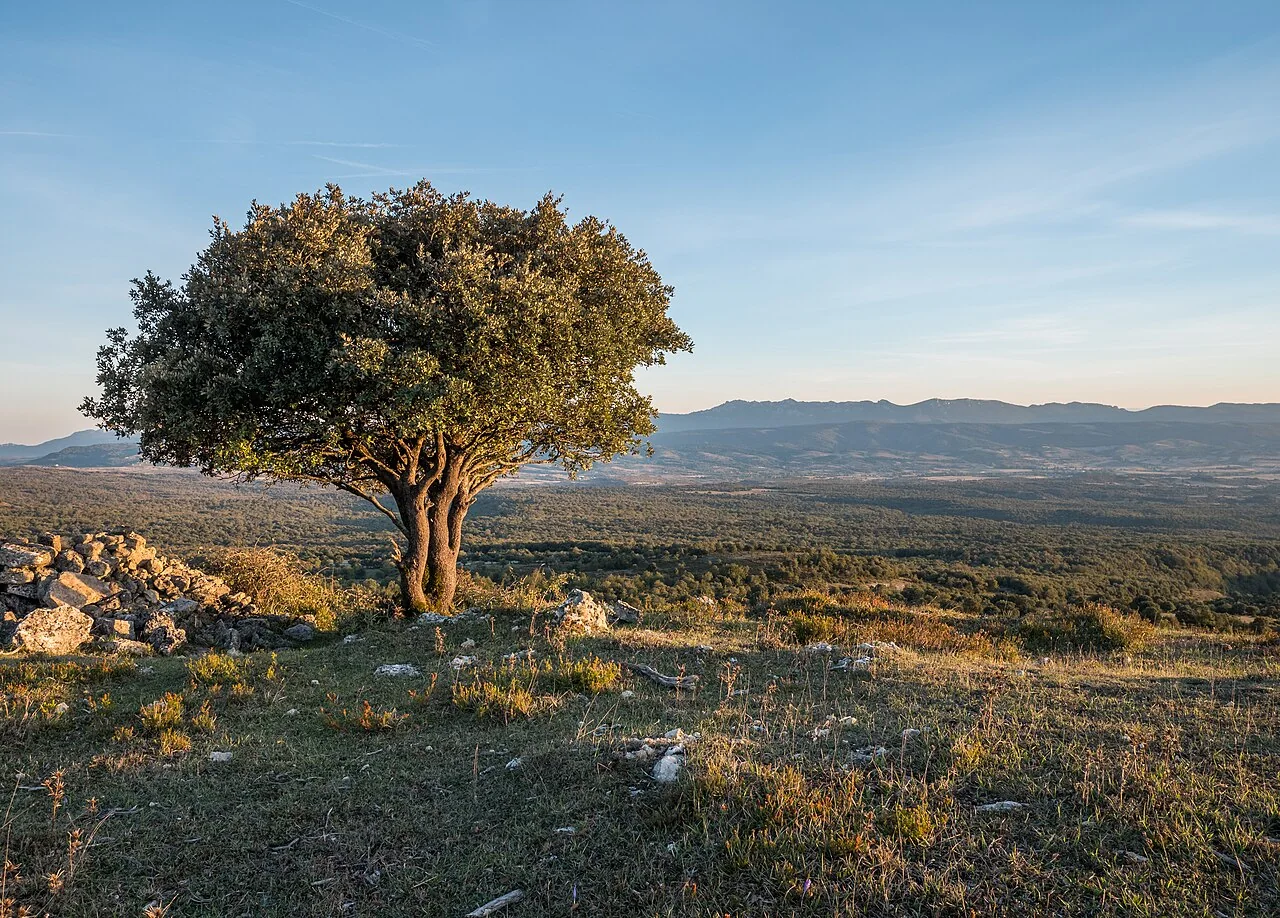
A Quercus ilex tree.
Basotxerri / Wikimedia Commons / CC BY-SA 4.0

Photo details
Resized and converted to WebP. No content edits.
Source: File:Montes de Vitoria - Quercus ilex 01.jpg
Reviewed . Source identification, photograph and license reviewed. The image illustrates the named plant; it does not verify dimensions or other plant traits.
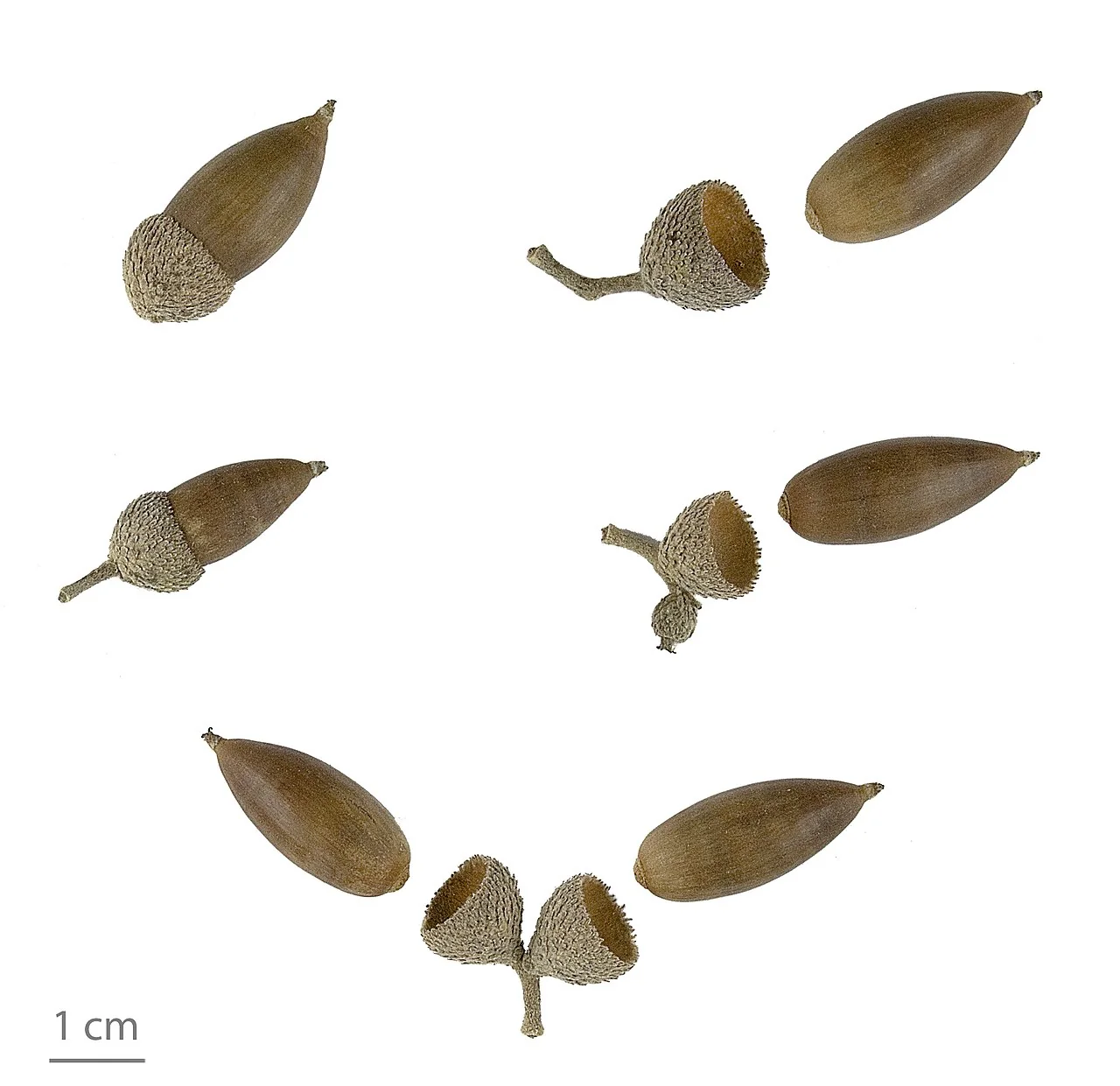
Acorns and cups of Quercus ilex, shown with a scale.
Roger Culos / Wikimedia Commons / CC BY-SA 3.0

Photo details
Resized and converted to WebP. No content edits.
Source: File:Quercus ilex MHNT.2006.0.1268.JPG
Reviewed . Source identification, photograph and license reviewed. The image illustrates the named plant; it does not verify dimensions or other plant traits.
Common names
44 names · 31 languagesOther languages (30)
- Dutch
-
- Steeneik[1]
- Afrikaans
-
- holmeik[1]
- Albanian
-
- ilqe[1]
- Asturian
-
- ancina[1]
- Basque
-
- Artea[1]
- Catalan
-
+1 more nameShow fewer names
- Alzina vera[1]
- Croatian
-
- Hrast crnika[1]
- Danish
-
- Sten-eg[1]
- Finnish
-
- rautatammi[1]
- Hebrew
-
- אלון הגלעין[1]
- Hungarian
-
- Magyaltölgy[1]
- Italian
-
- Leccio[1]
- Japanese
-
- セイヨウヒイラギガシ[1]
- Lithuanian
-
- Akmeninis ąžuolas[1]
- Polish
-
- dąb ostrolistny[1]
- Russian
-
- Дуб каменный[1]
- Slovak
-
- dub cezmínovitý[1]
- Slovenian
-
- črničevje[1]
- Spanish
-
- Encina mediterránea[1]
- Swedish
-
- stenek[1]
- Thai
-
- โอ๊กโฮล์ม[1]
- Turkish
-
- Pırnal Meşe[1]
- Ukrainian
-
- Дуб кам'яний[1]
Sources & name notes (1)
Names recorded in our plant catalogue and botanical sources, grouped by language. Usage can vary by region.
Numbered references identify names recorded by an external source. Other names are from our plant catalogue.
Community-curated iNaturalist taxonomy; common-name attestation, not an independent botanical determination.
Source records
- chêne vert — results[2].names[1]; taxon id 78805; Quercus ilex.
- yeuse — results[2].names[2]; taxon id 78805; Quercus ilex.
- Leccio — results[2].names[3]; taxon id 78805; Quercus ilex.
- Holm oak — results[2].names[4]; taxon id 78805; Quercus ilex.
- holly oak — results[2].names[5]; taxon id 78805; Quercus ilex.
- Encina mediterránea — results[2].names[6]; taxon id 78805; Quercus ilex.
- Alzina litoral — results[2].names[7]; taxon id 78805; Quercus ilex.
- Alzina vera — results[2].names[8]; taxon id 78805; Quercus ilex.
- Alzina — results[2].names[9]; taxon id 78805; Quercus ilex.
- Steeneik — results[2].names[10]; taxon id 78805; Quercus ilex.
- dub cesmínovitý — results[2].names[11]; taxon id 78805; Quercus ilex.
- ancina — results[2].names[12]; taxon id 78805; Quercus ilex.
- dub cesmínovitý pravý — results[2].names[13]; taxon id 78805; Quercus ilex.
- Дуб каменный — results[2].names[14]; taxon id 78805; Quercus ilex.
- セイヨウヒイラギガシ — results[2].names[15]; taxon id 78805; Quercus ilex.
- stenek — results[2].names[16]; taxon id 78805; Quercus ilex.
- 冬青櫟 — results[2].names[17]; taxon id 78805; Quercus ilex.
- 冬青栎 — results[2].names[18]; taxon id 78805; Quercus ilex.
- Δρυς η Αριά — results[2].names[19]; taxon id 78805; Quercus ilex.
- Δρύς η Ίληξ — results[2].names[20]; taxon id 78805; Quercus ilex.
- azinheira-costeira — results[2].names[21]; taxon id 78805; Quercus ilex.
- azinheira-atlântica — results[2].names[22]; taxon id 78805; Quercus ilex.
- Sten-eg — results[2].names[23]; taxon id 78805; Quercus ilex.
- 圣栎 — results[2].names[24]; taxon id 78805; Quercus ilex.
- 聖櫟 — results[2].names[25]; taxon id 78805; Quercus ilex.
- črničevje — results[2].names[26]; taxon id 78805; Quercus ilex.
- Akmeninis ąžuolas — results[2].names[27]; taxon id 78805; Quercus ilex.
- Дуб кам'яний — results[2].names[28]; taxon id 78805; Quercus ilex.
- โอ๊กโฮล์ม — results[2].names[29]; taxon id 78805; Quercus ilex.
- Hrast crnika — results[2].names[30]; taxon id 78805; Quercus ilex.
- Magyaltölgy — results[2].names[31]; taxon id 78805; Quercus ilex.
- ilqe — results[2].names[32]; taxon id 78805; Quercus ilex.
- אלון הגלעין — results[2].names[33]; taxon id 78805; Quercus ilex.
- Pırnal Meşe — results[2].names[34]; taxon id 78805; Quercus ilex.
- rautatammi — results[2].names[35]; taxon id 78805; Quercus ilex.
- dąb ostrolistny — results[2].names[36]; taxon id 78805; Quercus ilex.
- evergreen oak — results[2].names[37]; taxon id 78805; Quercus ilex.
- dub cezmínovitý — results[2].names[38]; taxon id 78805; Quercus ilex.
- Artea — results[2].names[39]; taxon id 78805; Quercus ilex.
- Alzina de fulla llarga — results[2].names[40]; taxon id 78805; Quercus ilex.
- holmeik — results[2].names[41]; taxon id 78805; Quercus ilex.
- Steineiche — results[2].names[42]; taxon id 78805; Quercus ilex.
- Stein-Eiche — results[2].names[43]; taxon id 78805; Quercus ilex.
- Grün-Eiche — results[2].names[44]; taxon id 78805; Quercus ilex.
General information
Accepted in the cited Kew taxonomic treatment.
Sources [1]Plant characteristics
Growing conditions
Moist
Sand (light) Loam (medium) Clay (heavy)
Acidic Neutral Alkaline
Partial shade, Full sun
Uses
Oil, Seed
Hedge, Oil, Repellent, Windbreak, Wood, Carbon farming
Description
Seeds can be eaten raw or cooked and vary in flavor from sweet to bitter. They can be dried and ground into a powder, which can be used as a thickening agent in stews or mixed with grain to make bread. Some tree seeds contain bitter tannins that can be removed by thoroughly washing the seed in running water, although this may also result in the loss of minerals. Seeds can be used whole or dried and ground into powder. It can take some time to properly dehusk seeds; one method is to wrap them in a cloth and place them in a stream. Leaching the powder is quicker. A simple taste test can determine when the tannins have been washed out. A traditional method of preparing seeds was to bury them in moist soil and let them winter over. The sprouted seed would be dug up in the spring, when most of the contracting properties had been lost. Roasted seeds can serve as a coffee substitute. Edible oil can be extracted from seeds. In Morocco, there is a population of Quercus suber trees in the Mamora forests that produce only sweet acorns, which can be eaten raw and resemble raw chestnuts. The skin of the acorns can be easily removed. There are also tannin-free acorns found in the Moroccan forests of Quercus ilex, of which the local population claims that about 20% are sweet.
Harvest
Crown
Sources and references
References for the information marked with source numbers on this page.
-
Royal Botanic Gardens, Kew
World Checklist of Vascular Plants, version 16, extracted 4 June 2026
Relevant sections
- Botanical family: WCVP v16, wcvp_names.csv row 152857; name ID 171386; Quercus L.. Family column.
- Taxonomy: WCVP v16, wcvp_names.csv row 1088545; name ID 173162; Quercus ilex L..
Source checked on .
Source data licence: CC BY 3.0.