Petroselinum crispum
Parsley
Explore the size, hardiness, soil, light, edible uses and harvest period of Petroselinum crispum.
Plant photos
2 photos · Select to enlarge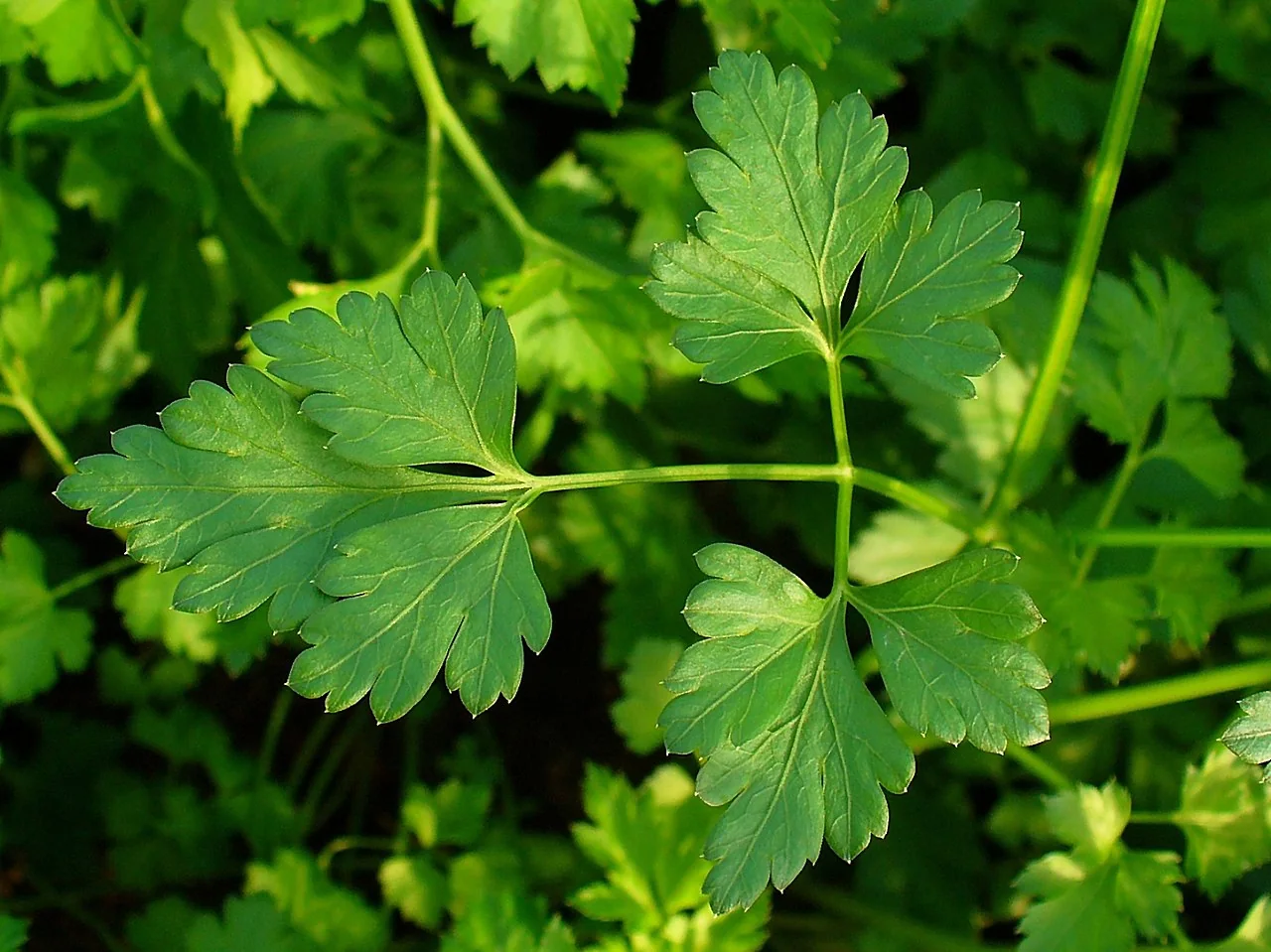
Leaves of Petroselinum crispum.
H. Zell / Wikimedia Commons / CC BY-SA 3.0

Photo details
Resized and converted to WebP. No content edits.
Source: File:Petroselinum crispum 003.JPG
Reviewed . Source identification, photograph and license reviewed. The image illustrates the named plant; it does not verify dimensions or other plant traits.
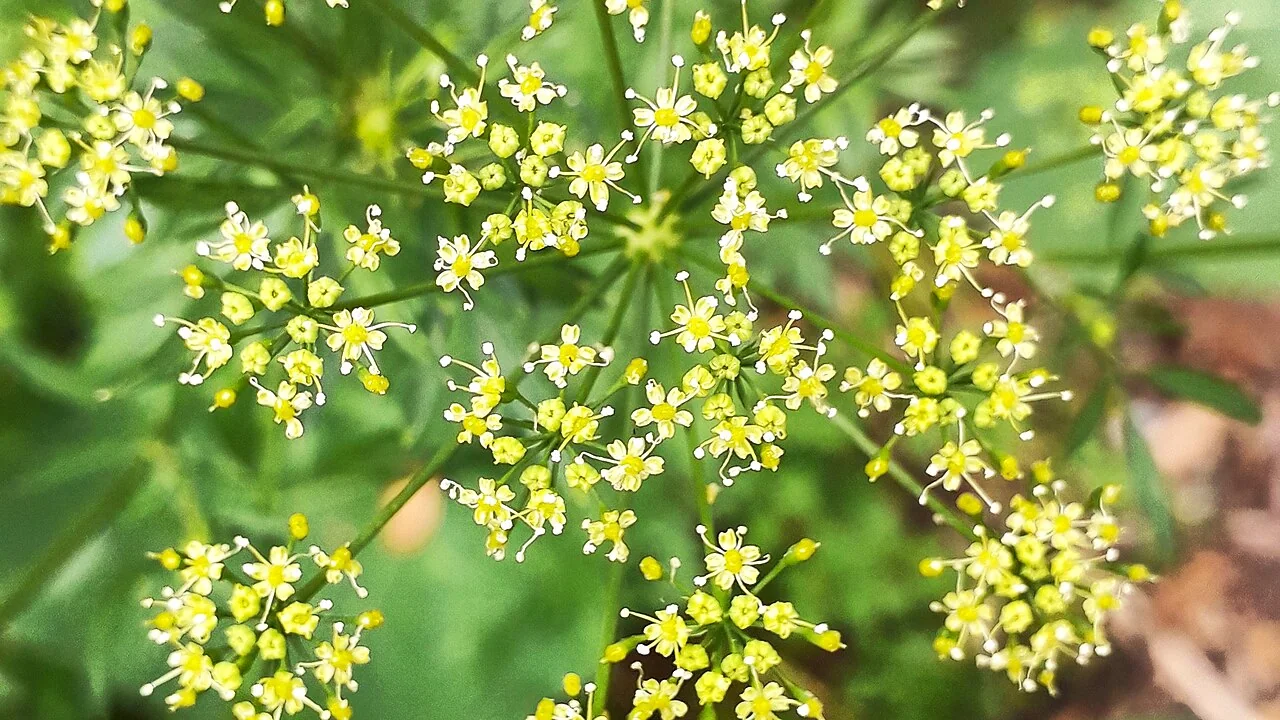
Flowers of Petroselinum crispum.
Wikiseelie Y / Wikimedia Commons / CC BY 4.0

Photo details
Resized and converted to WebP. No content edits.
Source: File:Flor de salsa.jpg
Reviewed . Source identification, photograph and license reviewed. The image illustrates the named plant; it does not verify dimensions or other plant traits.
Common names
43 names · 32 languagesOther languages (31)
- Dutch
-
- Krulpeterselie
- Tuinpeterselie[1]
- French
-
- Persil
- persil cultivé[1]
- Arabic
-
- بقدونس[1]
- Armenian
-
- Մաղադանոս[1]
- Catalan
-
- Julivert[1]
- Chinese (Traditional)
-
- 歐芹[1]
- Czech
-
- petržel obecná[1]
- Danish
-
- Persille[1]
- Esperanto
-
- Petroselo[1]
- Estonian
-
- aedpetersell[1]
- Finnish
-
- maustepersilja[1]
- German
-
- Petersilie[1]
- Hebrew
-
- פטרוזיליה (תרבותי)[1]
- Hungarian
-
- kerti petrezselyem[1]
- Italian
-
- prezzemolo[1]
- Laadan
-
- aálesh[1]
- Lithuanian
-
- Sėjamoji petražolė[1]
- Norwegian
-
- persille[1]
- Polish
-
- Pietruszka zwyczajna[1]
- Russian
-
- Петрушка кудрявая[1]
- Slovak
-
- petržlen záhradný[1]
- Slovenian
-
- peteršilj[1]
- Swedish
-
- persilja[1]
- Thai
-
- พาร์สลีย์[1]
- Turkish
-
- maydanoz[1]
- Ukrainian
-
- Петрушка кучерява (Петрушка городня)[1]
Sources & name notes (1)
Names recorded in our plant catalogue and botanical sources, grouped by language. Usage can vary by region.
Numbered references identify names recorded by an external source. Other names are from our plant catalogue.
Community-curated iNaturalist taxonomy; common-name attestation, not an independent botanical determination.
Source records
- garden parsley — results[0].names[1]; taxon id 78465; Petroselinum crispum.
- Perejil chino — results[0].names[2]; taxon id 78465; Petroselinum crispum.
- parsley — results[0].names[3]; taxon id 78465; Petroselinum crispum.
- Perejil — results[0].names[4]; taxon id 78465; Petroselinum crispum.
- Salsa — results[0].names[5]; taxon id 78465; Petroselinum crispum.
- persil cultivé — results[0].names[6]; taxon id 78465; Petroselinum crispum.
- Italian parsley — results[0].names[7]; taxon id 78465; Petroselinum crispum.
- Petersilie — results[0].names[8]; taxon id 78465; Petroselinum crispum.
- petržel obecná — results[0].names[9]; taxon id 78465; Petroselinum crispum.
- Persille — results[0].names[10]; taxon id 78465; Petroselinum crispum.
- salsinha — results[0].names[11]; taxon id 78465; Petroselinum crispum.
- perrexil — results[0].names[12]; taxon id 78465; Petroselinum crispum.
- prezzemolo — results[0].names[13]; taxon id 78465; Petroselinum crispum.
- 歐芹 — results[0].names[14]; taxon id 78465; Petroselinum crispum.
- persille — results[0].names[15]; taxon id 78465; Petroselinum crispum.
- maustepersilja — results[0].names[16]; taxon id 78465; Petroselinum crispum.
- Petroselo — results[0].names[17]; taxon id 78465; Petroselinum crispum.
- Петрушка кудрявая — results[0].names[18]; taxon id 78465; Petroselinum crispum.
- Sėjamoji petražolė — results[0].names[19]; taxon id 78465; Petroselinum crispum.
- petržlen záhradný — results[0].names[20]; taxon id 78465; Petroselinum crispum.
- Tuinpeterselie — results[0].names[21]; taxon id 78465; Petroselinum crispum.
- persilja — results[0].names[22]; taxon id 78465; Petroselinum crispum.
- オランダゼリ — results[0].names[23]; taxon id 78465; Petroselinum crispum.
- aedpetersell — results[0].names[24]; taxon id 78465; Petroselinum crispum.
- 欧芹 — results[0].names[25]; taxon id 78465; Petroselinum crispum.
- aálesh — results[0].names[26]; taxon id 78465; Petroselinum crispum.
- Մաղադանոս — results[0].names[27]; taxon id 78465; Petroselinum crispum.
- maydanoz — results[0].names[28]; taxon id 78465; Petroselinum crispum.
- pieterselie — results[0].names[29]; taxon id 78465; Petroselinum crispum.
- pietersielie — results[0].names[30]; taxon id 78465; Petroselinum crispum.
- Петрушка кучерява (Петрушка городня) — results[0].names[31]; taxon id 78465; Petroselinum crispum.
- Pietruszka zwyczajna — results[0].names[32]; taxon id 78465; Petroselinum crispum.
- بقدونس — results[0].names[33]; taxon id 78465; Petroselinum crispum.
- kerti petrezselyem — results[0].names[34]; taxon id 78465; Petroselinum crispum.
- פטרוזיליה (תרבותי) — results[0].names[35]; taxon id 78465; Petroselinum crispum.
- พาร์สลีย์ — results[0].names[36]; taxon id 78465; Petroselinum crispum.
- 香芹 — results[0].names[37]; taxon id 78465; Petroselinum crispum.
- 洋芫荽 — results[0].names[38]; taxon id 78465; Petroselinum crispum.
- 旱芹 — results[0].names[39]; taxon id 78465; Petroselinum crispum.
- Julivert — results[0].names[40]; taxon id 78465; Petroselinum crispum.
- peteršilj — results[0].names[41]; taxon id 78465; Petroselinum crispum.
General information
Accepted in the cited Kew taxonomic treatment.
Sources [1]Kew's family placement for the genus Petroselinum (WCVP v16).
Sources [1]Plant characteristics
NC State landscape size range; converted from feet and inches. Size varies with site, age and management.
Sources [2]NC State landscape size range; converted from feet and inches. Size varies with site, age and management.
Sources [2]Uses
Leaves, Tea
Essential oil, Repellent, Bee forage, Fragrant
Description
Parsley leaves can be eaten raw or cooked. They are often used as a garnish or flavoring in salads and warm dishes, but their strong taste can be overwhelming. Parsley is an important ingredient in the herb mix 'bouquet garni.' To encourage continuous growth and achieve maximum yield, it is important to regularly harvest the leaves. Drying the leaves is difficult, but freezing is an easy option. For drying, the leaves need a well-ventilated area with plenty of sunlight and should be kept sharp to preserve their flavor. Parsley is very rich in iron, iodine, and magnesium, and is a good source of vitamins A, B, and C. The stems can be dried and ground to be used as a coloring agent. Tea made from fresh or dried leaves contains a lot of vitamin C. Essential oil is extracted from the leaves, which is primarily used as a commercial food flavoring. About 1% of the essential oil comes from the leaves, while about 6% is obtained from the seeds. Caution is advised when using the plant, especially with the essential oil.
Harvest
Sources and references
References for the information marked with source numbers on this page.
-
Royal Botanic Gardens, Kew
World Checklist of Vascular Plants, version 16, extracted 4 June 2026
Relevant sections
- Botanical family: WCVP v16, wcvp_names.csv row 125665; name ID 2403245; Petroselinum Hill. Family column.
- Taxonomy: WCVP v16, wcvp_names.csv row 1420382; name ID 2898243; Petroselinum crispum (Mill.) Fuss.
Source checked on .
Source data licence: CC BY 3.0.
-
NC State Extension, North Carolina State University
Petroselinum crispum — Extension Gardener Plant Toolbox
Relevant sections
- Height: Dimensions > Height; Height: 0 ft. 8 in. - 3 ft. 0 in.
- Spread: Dimensions > Width; Width: 0 ft. 8 in. - 1 ft. 0 in.
- Growth rate: Growth Rate
- Growth habit: Habit/Form
- Life cycle: Life Cycle
- Light: Light
- Soil moisture: Soil Drainage
- Soil texture: Soil Texture
- Soil pH: Soil pH
Source checked on .