Myrrhis odorata
Sweet cicely
Explore the size, hardiness, soil, light, edible uses and harvest period of Myrrhis odorata.
Plant photos
2 photos · Select to enlarge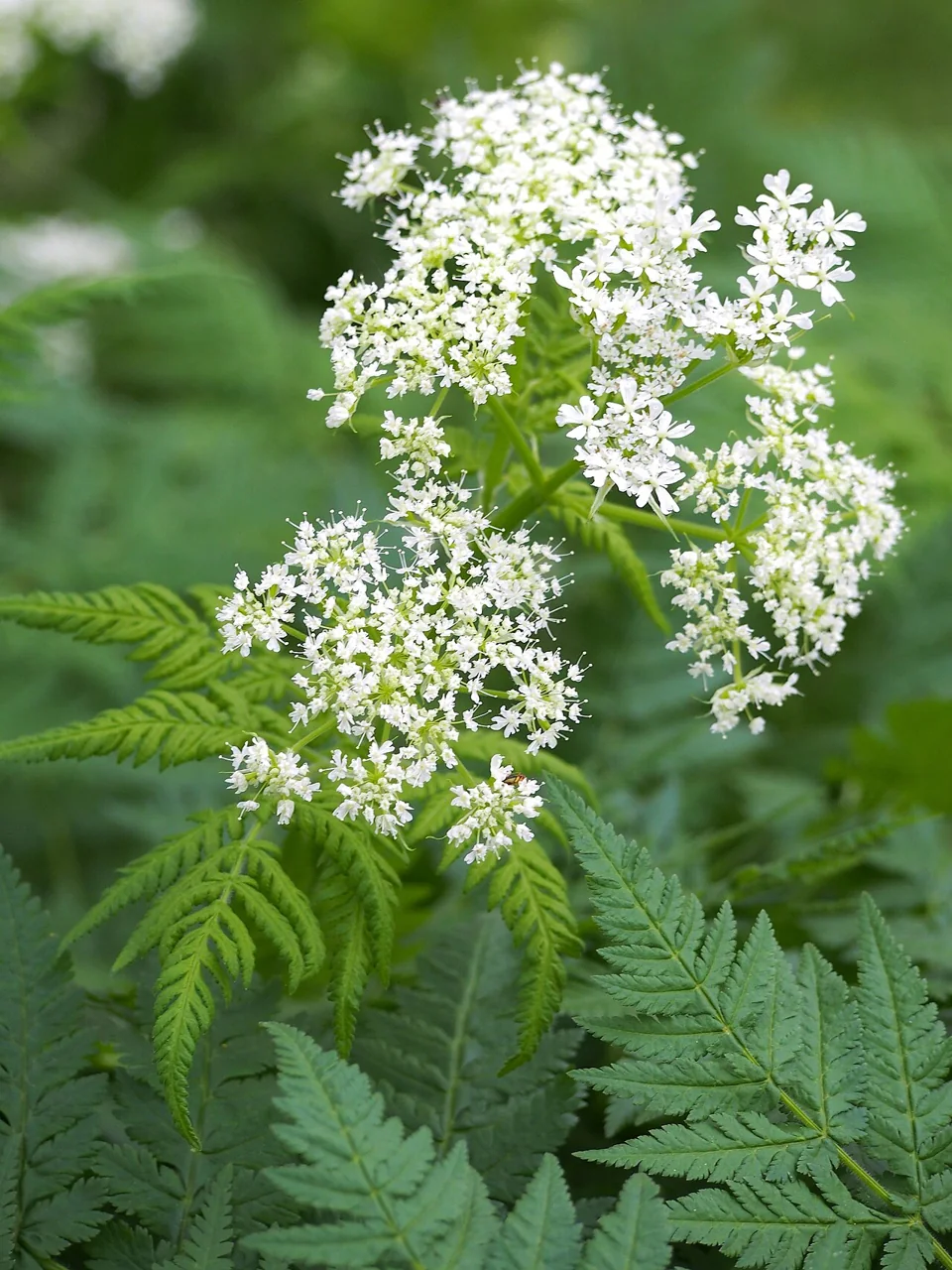
Myrrhis odorata in flower.
Agnieszka Kwiecień, Nova / Wikimedia Commons / CC BY-SA 4.0

Photo details
Resized and converted to WebP. No content edits.
Source: File:Myrrhis odorata Marchewnik anyżowy 2021-05-14 01.jpg
Reviewed . Source identification, photograph and license reviewed. The image illustrates the named plant; it does not verify dimensions or other plant traits.
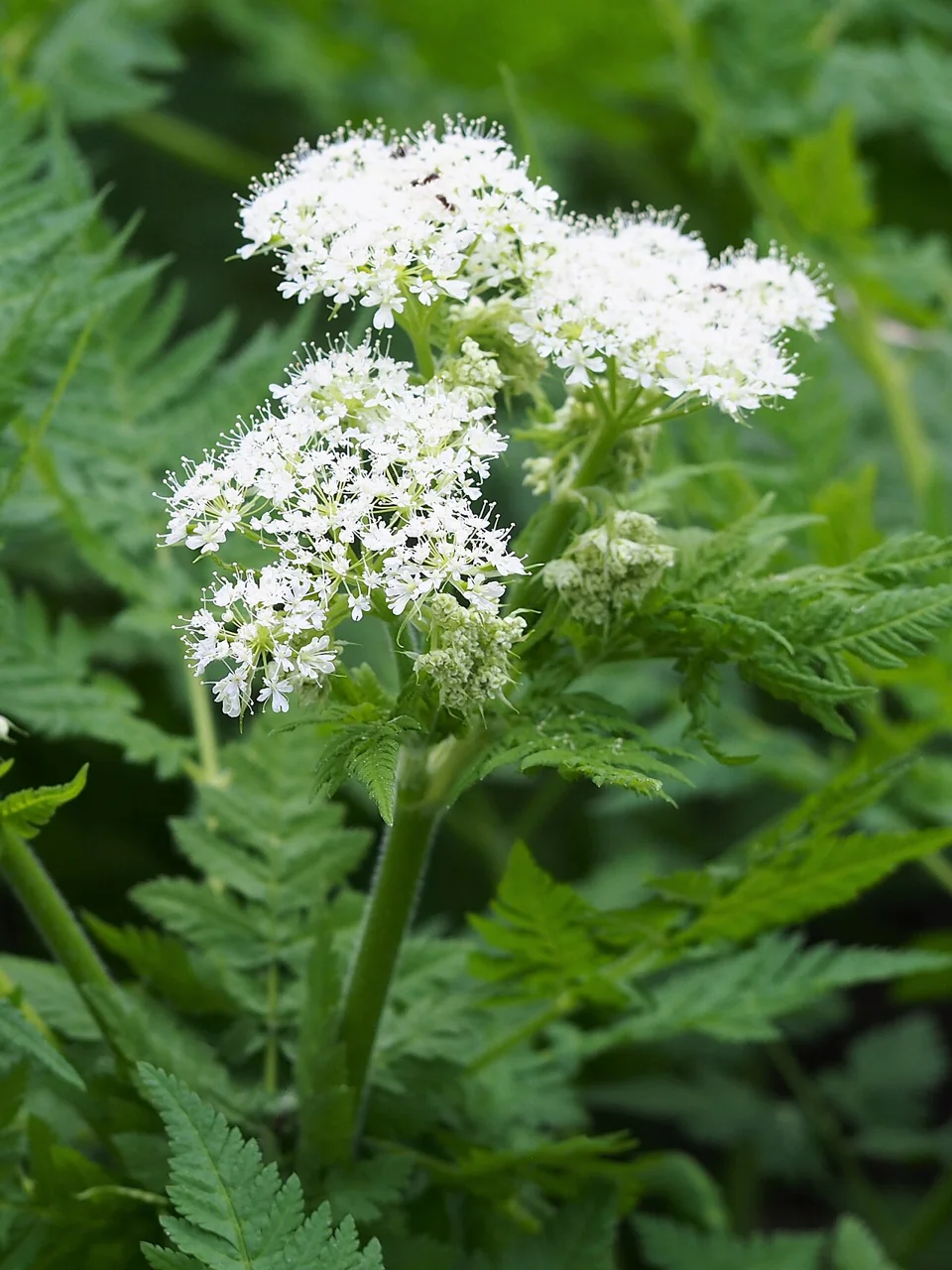
Flowers of Myrrhis odorata.
Agnieszka Kwiecień, Nova / Wikimedia Commons / CC BY-SA 4.0

Photo details
Resized and converted to WebP. No content edits.
Source: File:Myrrhis odorata Marchewnik anyżowy 2022-05-03 01.jpg
Reviewed . Source identification, photograph and license reviewed. The image illustrates the named plant; it does not verify dimensions or other plant traits.
Common names
28 names · 21 languagesOther languages (20)
- Dutch
-
- Roomse kervel[2]
- Catalan
-
- Mirris[2]
- Czech
-
- čechřice vonná[2]
- Danish
-
- Sødskærm[2]
- Estonian
-
- Mesiputk[2]
- Faroese
-
- søtur urtakervil[2]
- Finnish
-
- saksankirveli[2]
- Icelandic
-
- Spánarkerfill[2]
- Italian
-
- Mirride delle Alpi[2]
- Lithuanian
-
- Kvapioji garduoklė[2]
- Norwegian
-
- spansk kjørvel[2]
- Polish
-
- Marchewnik anyżowy[2]
- Slovak
-
- čechrica voňavá[2]
- Slovenian
-
- dišeči kromač[2]
- Swedish
-
- spansk körvel[2]
Sources & name notes (2)
Names recorded in our plant catalogue and botanical sources, grouped by language. Usage can vary by region.
Numbered references identify names recorded by an external source. Other names are from our plant catalogue.
Common names from World Plants, version 26.05, reproduced in Catalogue of Life 2026-08-20. License: CC BY.
Source records
- Sweet Cicely (EN) — VernacularName.tsv, line 139063; taxon 45DGC.
- Süßdolde (DE) — VernacularName.tsv, line 139064; taxon 45DGC.
Community-curated iNaturalist taxonomy; common-name attestation, not an independent botanical determination.
Source records
- sweet cicely — results[0].names[1]; taxon id 51618; Myrrhis odorata.
- čechřice vonná — results[0].names[2]; taxon id 51618; Myrrhis odorata.
- Миррис душистая — results[0].names[3]; taxon id 51618; Myrrhis odorata.
- Cerfeuil musqué — results[0].names[4]; taxon id 51618; Myrrhis odorata.
- Cerfeuil anisé — results[0].names[5]; taxon id 51618; Myrrhis odorata.
- Sødskærm — results[0].names[6]; taxon id 51618; Myrrhis odorata.
- spansk kjørvel — results[0].names[7]; taxon id 51618; Myrrhis odorata.
- saksankirveli — results[0].names[8]; taxon id 51618; Myrrhis odorata.
- Süßdolde — results[0].names[9]; taxon id 51618; Myrrhis odorata.
- spansk körvel — results[0].names[10]; taxon id 51618; Myrrhis odorata.
- Kvapioji garduoklė — results[0].names[11]; taxon id 51618; Myrrhis odorata.
- 茉莉芹 — results[0].names[12]; taxon id 51618; Myrrhis odorata.
- 茉莉芹 — results[0].names[13]; taxon id 51618; Myrrhis odorata.
- 歐洲沒藥 — results[0].names[14]; taxon id 51618; Myrrhis odorata.
- 甜没藥 — results[0].names[15]; taxon id 51618; Myrrhis odorata.
- 欧洲没药 — results[0].names[16]; taxon id 51618; Myrrhis odorata.
- 甜没药 — results[0].names[17]; taxon id 51618; Myrrhis odorata.
- Roomse kervel — results[0].names[18]; taxon id 51618; Myrrhis odorata.
- dišeči kromač — results[0].names[19]; taxon id 51618; Myrrhis odorata.
- søtur urtakervil — results[0].names[20]; taxon id 51618; Myrrhis odorata.
- Mesiputk — results[0].names[21]; taxon id 51618; Myrrhis odorata.
- Кервель душистый — results[0].names[22]; taxon id 51618; Myrrhis odorata.
- Кервель испанский — results[0].names[23]; taxon id 51618; Myrrhis odorata.
- Mirris — results[0].names[24]; taxon id 51618; Myrrhis odorata.
- Mirride delle Alpi — results[0].names[25]; taxon id 51618; Myrrhis odorata.
- Marchewnik anyżowy — results[0].names[26]; taxon id 51618; Myrrhis odorata.
- Spánarkerfill — results[0].names[27]; taxon id 51618; Myrrhis odorata.
- čechrica voňavá — results[0].names[28]; taxon id 51618; Myrrhis odorata.
General information
Plant characteristics
Growing conditions
Moist
Sand (light) Loam (medium) Clay (heavy)
Acidic Neutral Alkaline
Partial shade, Full sun
Uses
Leaves, Root, Seed, Tea
Bee forage
Description
Leaves can be eaten both raw and cooked. They have a delicious sweet anise flavor and are loved by most people. The leaves are often used as a seasoning for vegetables and are an essential ingredient in the herb mixture 'bouquet garni'. They can also be added to dishes with sour fruits to reduce acidity. The plant produces fresh leaves from late winter to early the following winter. These leaves can also be dried for later use. It is best to avoid allowing the plant to flower when the leaves are needed for culinary use, as they will lose their flavor then. The root of the plant can be eaten raw or cooked and has a similar taste to the leaf. As long as the root is not too old, it can be cooked and added to other vegetables or salads. The seeds of the plant have an anise flavor and are usually used as a seasoning. They can also be eaten raw when they are still green, before the fibrous layer forms. The seeds also work well as a breath freshener. Tea can be made from the leaves.
Harvest
Sources and references
References for the information marked with source numbers on this page.
-
Royal Botanic Gardens, Kew
World Checklist of Vascular Plants, version 16, extracted 4 June 2026
Relevant sections
- Botanical family: WCVP v16, wcvp_names.csv row 77946; name ID 2363768; Myrrhis Mill.. Family column.
- Taxonomy: WCVP v16, wcvp_names.csv row 77923; name ID 2363724; Myrrhis odorata (L.) Scop..
Source checked on .
Source data licence: CC BY 3.0.
-
Catalogue of Life
Catalogue of Life 2026-08-20 — Myrrhis odorata
Taxonomic data from World Plants, version 26.05, reproduced in Catalogue of Life 2026-08-20.
Supports: TaxonomyRelevant sections
- Taxonomy: COL 2026-08-20, NameUsage.tsv line 716772, ID 45DGC: Myrrhis odorata (L.) Scop. (accepted).
Source checked on .