Medicago sativa
Alfalfa, Yellow alfalfa
Explore the size, hardiness, soil, light, edible uses and harvest period of Medicago sativa.
Plant photos
2 photos · Select to enlarge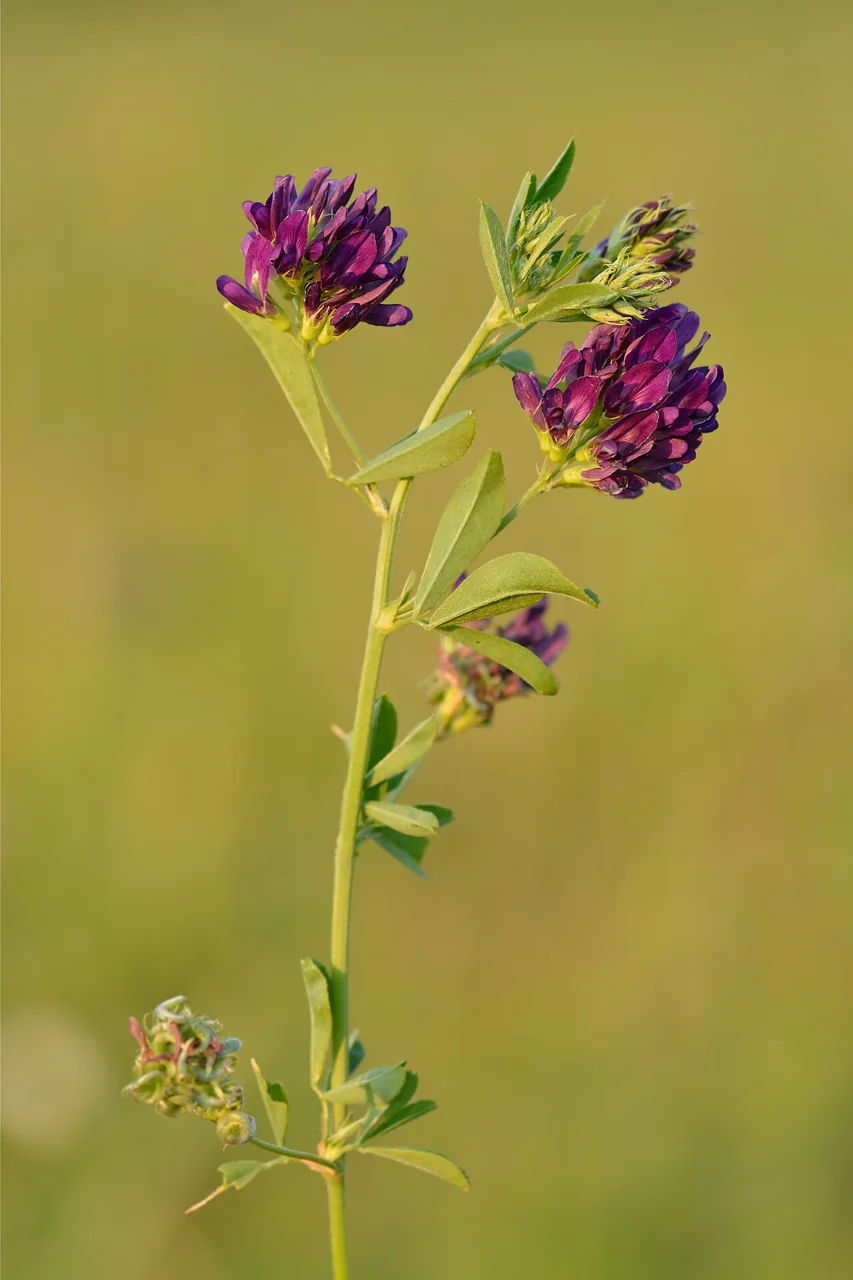
Flowers of Medicago sativa.
Ivar Leidus / Wikimedia Commons / CC BY-SA 3.0

Photo details
Resized and converted to WebP. No content edits.
Source: File:Medicago sativa - harilik lutsern Keilas.jpg
Reviewed . Source identification, photograph and license reviewed. The image illustrates the named plant; it does not verify dimensions or other plant traits.
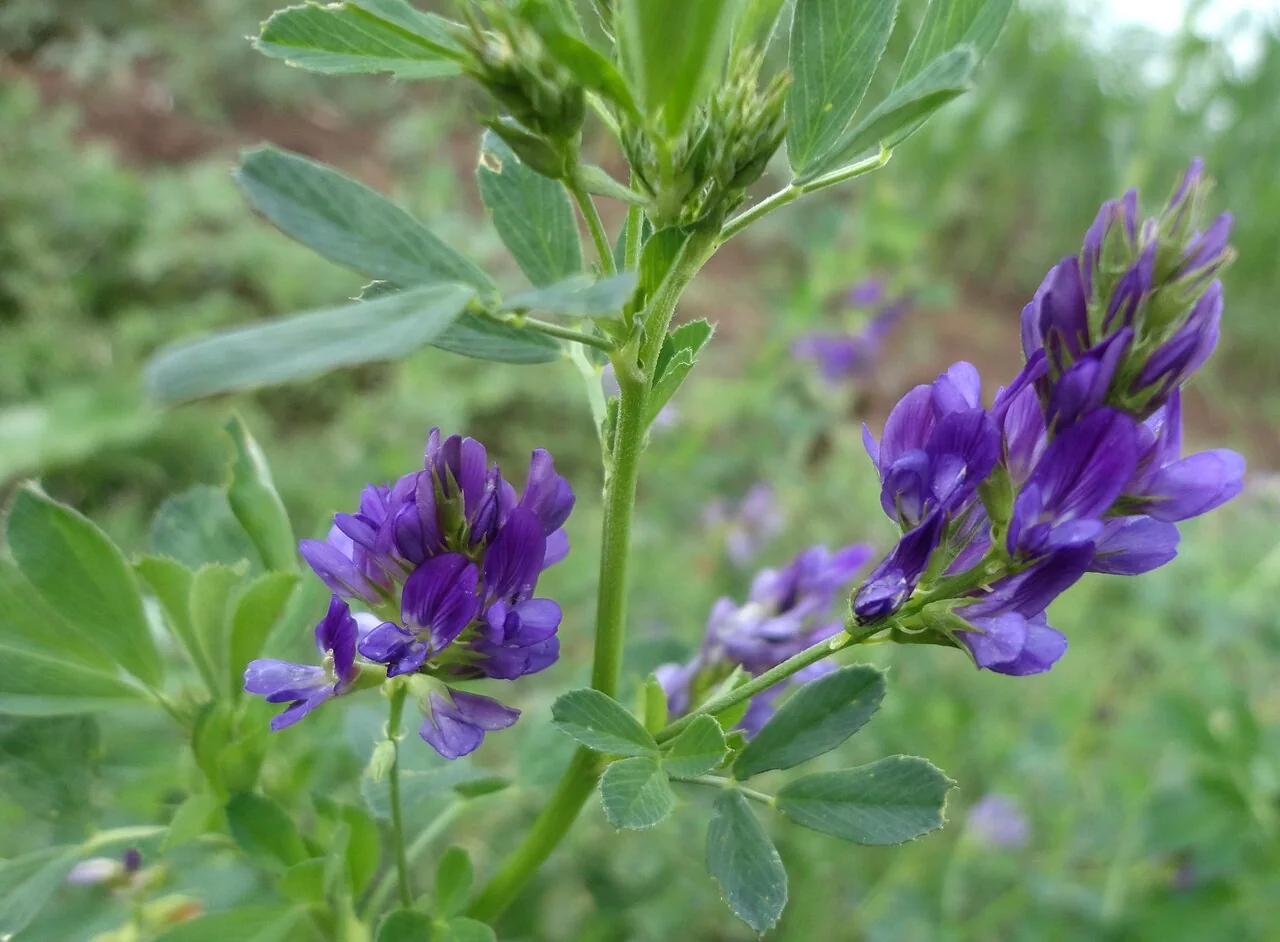
Flowers of Medicago sativa.
Juan Carlos Fonseca Mata / Wikimedia Commons / CC BY-SA 4.0
_I.jpg)
Photo details
Resized and converted to WebP. No content edits.
Source: File:Alfalfa (Medicago sativa) I.jpg
Reviewed . Source identification, photograph and license reviewed. The image illustrates the named plant; it does not verify dimensions or other plant traits.
Common names
56 names · 40 languagesOther languages (39)
- Dutch
-
- Luzerne[1]
- Afrikaans
-
- Lusern[1]
- Arapaho
-
- niisniikou'usei'i[1]
- Armenian
-
- Առվույտ[1]
- Belarusian
-
- Люцэрна пасяўная або сіняя[1]
- Chinese (Traditional)
-
- 紫苜蓿[1]
- Croatian
-
- Lucerna[1]
- Czech
-
- tolice vojtěška[1]
- Danish
-
- Lucerne[1]
- Estonian
-
- harilik lutsern[1]
- Finnish
-
- sinimailanen[1]
- German
-
- Luzerne[1]
- Greek
-
- Τριφύλλι Αλφάλφα[1]
- Hebrew
-
- אספסת תרבותית[1]
- Hungarian
-
- takarmánylucerna[1]
- Korean
-
- 자주개자리[1]
- Latvian
-
- Sējas lucerna[1]
- Lithuanian
-
- Mėlynžiedė liucerna[1]
- Malay
-
- alfalfa[1]
- Mono
-
- sonabü[1]
- Norwegian
-
- blålusern[1]
- Polish
-
- Lucerna siewna[1]
- Russian
-
- Люцерна посевная[1]
- Serbian
-
- Луцерка[1]
- Slovak
-
- lucerna siata[1]
- Slovenian
-
- lucerna[1]
- Swedish
-
- foderlusern[1]
- Ukrainian
-
- Люцерна посівна[1]
- Welsh
-
- Maglys[1]
- Zapoteco
-
- coba-picina-xi-castilla[1]
Sources & name notes (1)
Names recorded in our plant catalogue and botanical sources, grouped by language. Usage can vary by region.
Numbered references identify names recorded by an external source. Other names are from our plant catalogue.
Community-curated iNaturalist taxonomy; common-name attestation, not an independent botanical determination.
Source records
- Alfalfa — results[1].names[1]; taxon id 57057; Medicago sativa.
- Alfalfa — results[1].names[2]; taxon id 57057; Medicago sativa.
- Luzerne cultivée — results[1].names[3]; taxon id 57057; Medicago sativa.
- coba-picina-xi-castilla — results[1].names[4]; taxon id 57057; Medicago sativa.
- ムラサキウマゴヤシ — results[1].names[6]; taxon id 57057; Medicago sativa.
- Lucerne — results[1].names[7]; taxon id 57057; Medicago sativa.
- sinimailanen — results[1].names[8]; taxon id 57057; Medicago sativa.
- Luzerne — results[1].names[9]; taxon id 57057; Medicago sativa.
- Alfafa — results[1].names[10]; taxon id 57057; Medicago sativa.
- Luzerna — results[1].names[11]; taxon id 57057; Medicago sativa.
- Alfalfa — results[1].names[12]; taxon id 57057; Medicago sativa.
- אספסת תרבותית — results[1].names[13]; taxon id 57057; Medicago sativa.
- Люцерна посевная — results[1].names[14]; taxon id 57057; Medicago sativa.
- Luzerne — results[1].names[15]; taxon id 57057; Medicago sativa.
- tolice vojtěška — results[1].names[16]; taxon id 57057; Medicago sativa.
- Userda — results[1].names[17]; taxon id 57057; Medicago sativa.
- Mėlynžiedė liucerna — results[1].names[18]; taxon id 57057; Medicago sativa.
- blålusern — results[1].names[19]; taxon id 57057; Medicago sativa.
- erba medica — results[1].names[20]; taxon id 57057; Medicago sativa.
- erba Spagna — results[1].names[21]; taxon id 57057; Medicago sativa.
- Alfalfa — results[1].names[22]; taxon id 57057; Medicago sativa.
- برسيم حجازي — results[1].names[23]; taxon id 57057; Medicago sativa.
- Lucerna siewna — results[1].names[24]; taxon id 57057; Medicago sativa.
- فصة معمرة — results[1].names[25]; taxon id 57057; Medicago sativa.
- فصفصة — results[1].names[26]; taxon id 57057; Medicago sativa.
- Luzerne — results[1].names[27]; taxon id 57057; Medicago sativa.
- Lucerne — results[1].names[28]; taxon id 57057; Medicago sativa.
- afarfa — results[1].names[29]; taxon id 57057; Medicago sativa.
- foderlusern — results[1].names[30]; taxon id 57057; Medicago sativa.
- 苜蓿 — results[1].names[31]; taxon id 57057; Medicago sativa.
- 紫苜蓿 — results[1].names[32]; taxon id 57057; Medicago sativa.
- 紫苜蓿 — results[1].names[33]; taxon id 57057; Medicago sativa.
- アルファルファ — results[1].names[34]; taxon id 57057; Medicago sativa.
- Τριφύλλι Αλφάλφα — results[1].names[35]; taxon id 57057; Medicago sativa.
- harilik lutsern — results[1].names[36]; taxon id 57057; Medicago sativa.
- niisniikou'usei'i — results[1].names[37]; taxon id 57057; Medicago sativa.
- Առվույտ — results[1].names[38]; taxon id 57057; Medicago sativa.
- 자주개자리 — results[1].names[39]; taxon id 57057; Medicago sativa.
- alfaalfa — results[1].names[40]; taxon id 57057; Medicago sativa.
- Lusern — results[1].names[41]; taxon id 57057; Medicago sativa.
- Люцерна посівна — results[1].names[42]; taxon id 57057; Medicago sativa.
- Люцэрна пасяўная або сіняя — results[1].names[43]; taxon id 57057; Medicago sativa.
- lucerna — results[1].names[45]; taxon id 57057; Medicago sativa.
- Sējas lucerna — results[1].names[46]; taxon id 57057; Medicago sativa.
- takarmánylucerna — results[1].names[47]; taxon id 57057; Medicago sativa.
- Lucerna — results[1].names[48]; taxon id 57057; Medicago sativa.
- lucerna siata — results[1].names[49]; taxon id 57057; Medicago sativa.
- alfalfa — results[1].names[50]; taxon id 57057; Medicago sativa.
- 紫花苜蓿 — results[1].names[51]; taxon id 57057; Medicago sativa.
- Kara Yonca (Şark Yoncası) — results[1].names[52]; taxon id 57057; Medicago sativa.
- Alfals — results[1].names[53]; taxon id 57057; Medicago sativa.
- Maglys — results[1].names[54]; taxon id 57057; Medicago sativa.
- Луцерка — results[1].names[55]; taxon id 57057; Medicago sativa.
- sonabü — results[1].names[56]; taxon id 57057; Medicago sativa.
- Karayonca — results[1].names[57]; taxon id 57057; Medicago sativa.
General information
Plant characteristics
Growing conditions
Moist, Well-drained
Sand (light) Loam (medium) Clay (heavy)
Acidic Neutral Alkaline
Full sun
Uses
Leaves, Oil, Tea, Seed
Carbon farming, Hedge, Nitrogen fixer, Bee forage, Biomass production, Companion plant, Dye, Oil, Paper
Description
The leaves and young shoots of the alfalfa plant can be eaten both raw and cooked. The leaves are very rich in vitamin K and can be dried for later consumption. The young shoots are a good source of vitamins A, B, and C, and also contain proteins. Alfalfa is very nutritious, but consume it in moderation, as large quantities can be toxic. The seeds are usually only used in their sprouted form, for example in salads, on bread, or in soups. To sprout the seeds, they must be soaked in warm water for 12 hours, then kept moist and placed in a warm spot. The seeds will sprout within 4 to 6 days. They can also be ground into a powder and mixed with wheat flour, for example. Tea can be made from the leaves.
Harvest
Sources and references
References for the information marked with source numbers on this page.
-
Royal Botanic Gardens, Kew
World Checklist of Vascular Plants, version 16, extracted 4 June 2026
Relevant sections
- Botanical family: WCVP v16, wcvp_names.csv row 86485; name ID 2368626; Medicago L.. Family column.
- Taxonomy: WCVP v16, wcvp_names.csv row 86925; name ID 2369031; Medicago sativa L..
Source checked on .
Source data licence: CC BY 3.0.
-
Catalogue of Life
Catalogue of Life 2026-08-20 — Medicago sativa
Taxonomic data from WCVP-Fabaceae, version 2026, v.7, reproduced in Catalogue of Life 2026-08-20. This shares the Kew WCVP evidence base cited on this page.
Supports: TaxonomyRelevant sections
- Taxonomy: COL 2026-08-20, NameUsage.tsv line 611509, ID 3YNPB: Medicago sativa L. (accepted).
Source checked on .