Hippophae salicifolia
Willow-Leaved Sea Buckthorn
Explore the size, hardiness, soil, light, edible uses and harvest period of Hippophae salicifolia.
Plant photos
2 photos · Select to enlarge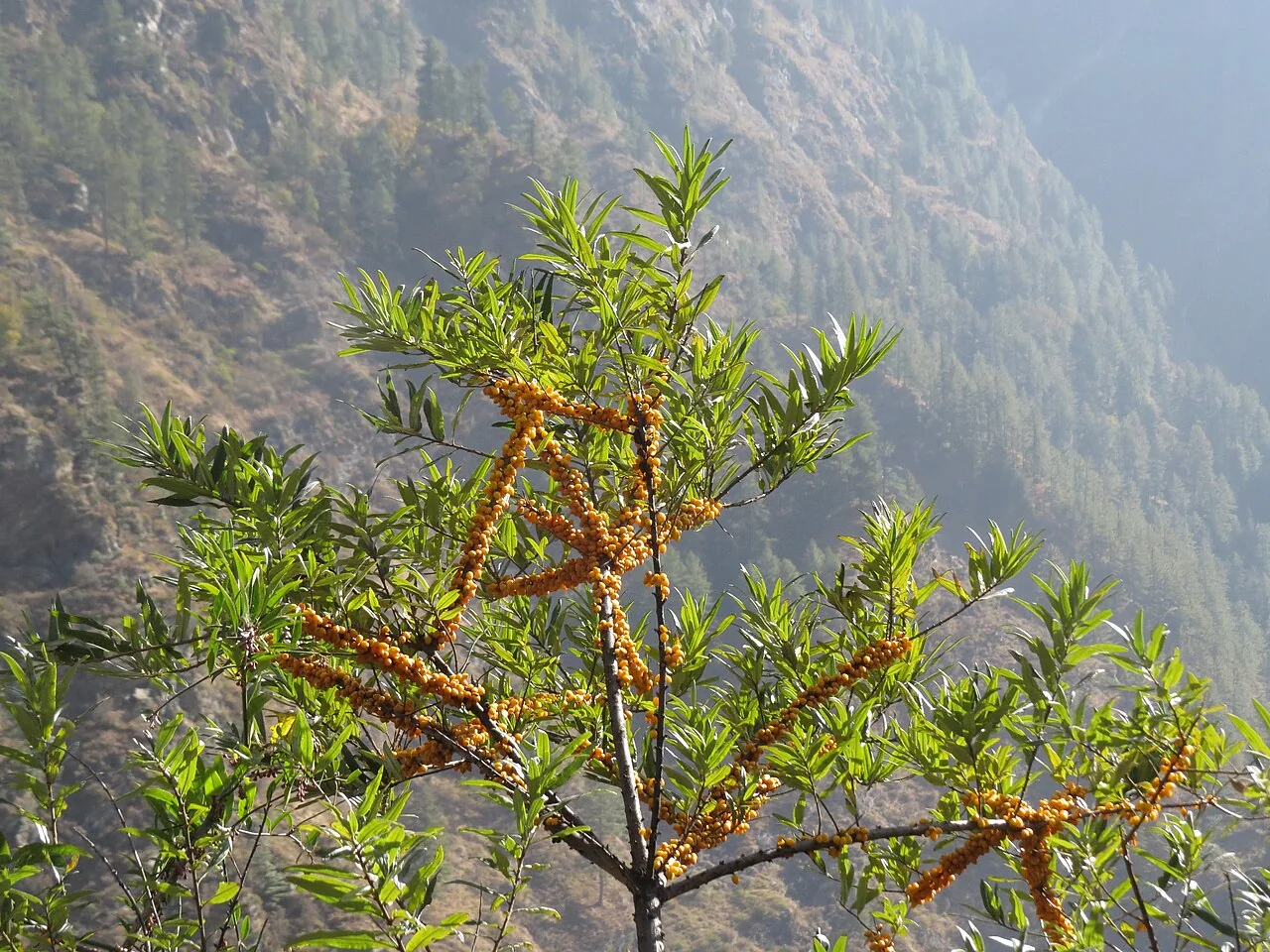
A fruiting Hippophae salicifolia plant.
A. J. T. Johnsingh, WWF-India and NCF / Wikimedia Commons / CC BY-SA 4.0

Photo details
Resized and converted to WebP. No content edits.
Source: File:Hippophae salicifolia, Gangotri landscape, Nov 2015, AJT Johnsingh. IMG 1254.jpg
Reviewed . Source identification, photograph and license reviewed. The image illustrates the named plant; it does not verify dimensions or other plant traits.
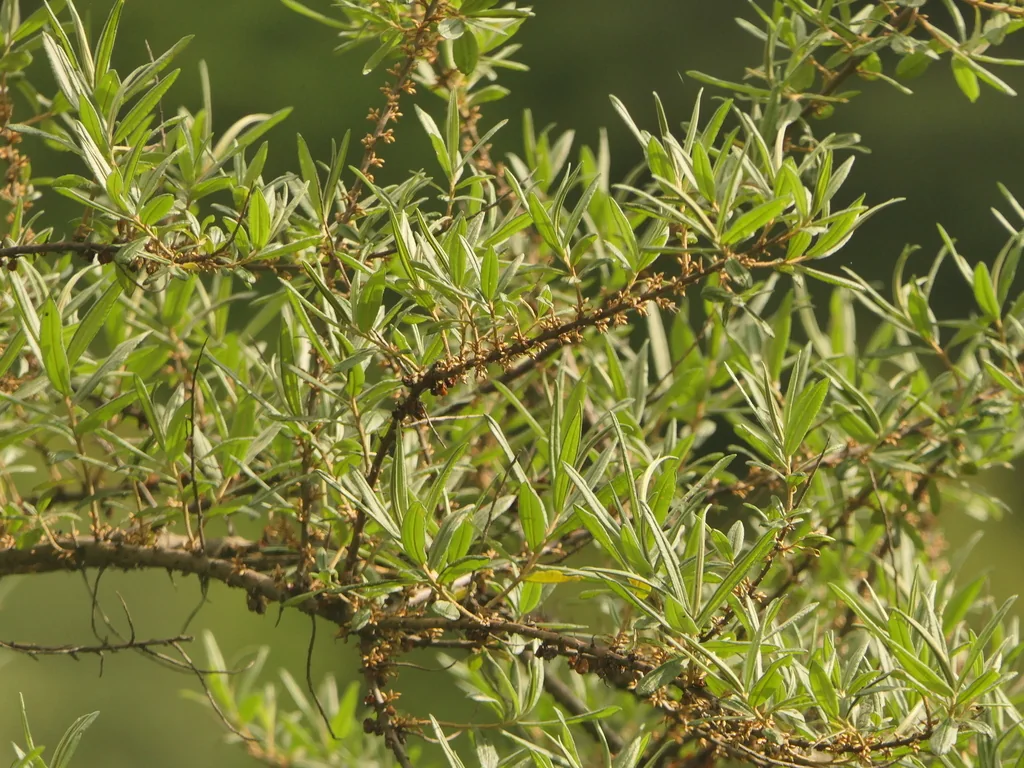
A leafy branch of Hippophae salicifolia.
(c) Sagnik Dutta Roy / iNaturalist / CC BY 4.0
Photo details
Resized and converted to WebP. No content edits.
Source: iNaturalist photo 530167809
View the observation and community identifications on iNaturalist.
Reviewed . The photographed view, exact taxon scope, current community identifications, per-photo license and source attribution were reviewed. The observation has at least two current agreeing community identifiers and no conflicting current species identification. The image illustrates plant appearance; it does not establish botanical measurements.
Common names
11 names · 11 languages- EnglishYour language
-
- Willow-Leaved Sea Buckthorn
Other languages (10)
- Dutch
-
- Wilgbladige duindoorn[1]
- French
-
- Argousier à feuilles de saule
- Chinese (Simplified)
-
- 柳叶沙棘[1]
- Chinese (Traditional)
-
- 柳葉沙棘[1]
- Czech
-
- rakytník vrbolistý[1]
- Finnish
-
- himalajantyrni[1]
- Lithuanian
-
- Gluosnialapis šaltalankis[1]
- Russian
-
- Облепиха иволистная[1]
- Slovak
-
- rakytník vŕbolistý[1]
- Swedish
-
- Himalayahavtorn[1]
Sources & name notes (1)
Names recorded in our plant catalogue and botanical sources, grouped by language. Usage can vary by region.
Numbered references identify names recorded by an external source. Other names are from our plant catalogue.
Community-curated iNaturalist taxonomy; common-name attestation, not an independent botanical determination.
Source records
- rakytník vrbolistý — results[1].names[1]; taxon id 968757; Hippophae salicifolia.
- 柳叶沙棘 — results[1].names[2]; taxon id 968757; Hippophae salicifolia.
- 柳葉沙棘 — results[1].names[3]; taxon id 968757; Hippophae salicifolia.
- Gluosnialapis šaltalankis — results[1].names[4]; taxon id 968757; Hippophae salicifolia.
- Облепиха иволистная — results[1].names[5]; taxon id 968757; Hippophae salicifolia.
- himalajantyrni — results[1].names[6]; taxon id 968757; Hippophae salicifolia.
- Wilgbladige duindoorn — results[1].names[7]; taxon id 968757; Hippophae salicifolia.
- Himalayahavtorn — results[1].names[8]; taxon id 968757; Hippophae salicifolia.
- rakytník vŕbolistý — results[1].names[9]; taxon id 968757; Hippophae salicifolia.
General information
Kew's family placement for the genus Hippophae (WCVP v16).
Sources [1]Plant characteristics
Growing conditions
Moist, Well-drained, Wet
Sand (light) Loam (medium) Clay (heavy)
Acidic Neutral Alkaline
Full sun
Uses
Fruit
Nitrogen fixer, Pioneer species, Wood
Description
Fruits: Whether raw or cooked, they are very nutritious and packed with vitamins (especially vitamin C), minerals, bioflavonoids, and essential fatty acids. These fruits are ripe in late summer, but can be eaten about a month earlier. They remain on the tree until well into winter, causing them to become softer and slightly milder in flavor. The fruits have a sour taste, similar to lemon, which becomes less sour when cooked. You can use them in salad dressings, when making jam, and increasingly in fruit juices, especially in combination with other fruits.
Harvest
Sources and references
References for the information marked with source numbers on this page.
-
Royal Botanic Gardens, Kew
World Checklist of Vascular Plants, version 16, extracted 4 June 2026
Relevant sections
- Botanical family: WCVP v16, wcvp_names.csv row 812382; name ID 2851538; Hippophae L.. Family column.
- Taxonomy: WCVP v16, wcvp_names.csv row 1409762; name ID 2851567; Hippophae salicifolia D.Don.
Source checked on .
Source data licence: CC BY 3.0.
-
Catalogue of Life
Catalogue of Life 2026-08-20 — Hippophae salicifolia
Taxonomic data from World Plants, version 26.05, reproduced in Catalogue of Life 2026-08-20.
Supports: TaxonomyRelevant sections
- Taxonomy: COL 2026-08-20, NameUsage.tsv line 2233596, ID 6M8JQ: Hippophae salicifolia D.Don (accepted).
Source checked on .