Allium ursinum
Wild garlic
Explore the size, hardiness, soil, light, edible uses and harvest period of Allium ursinum.
Plant photos
2 photos · Select to enlarge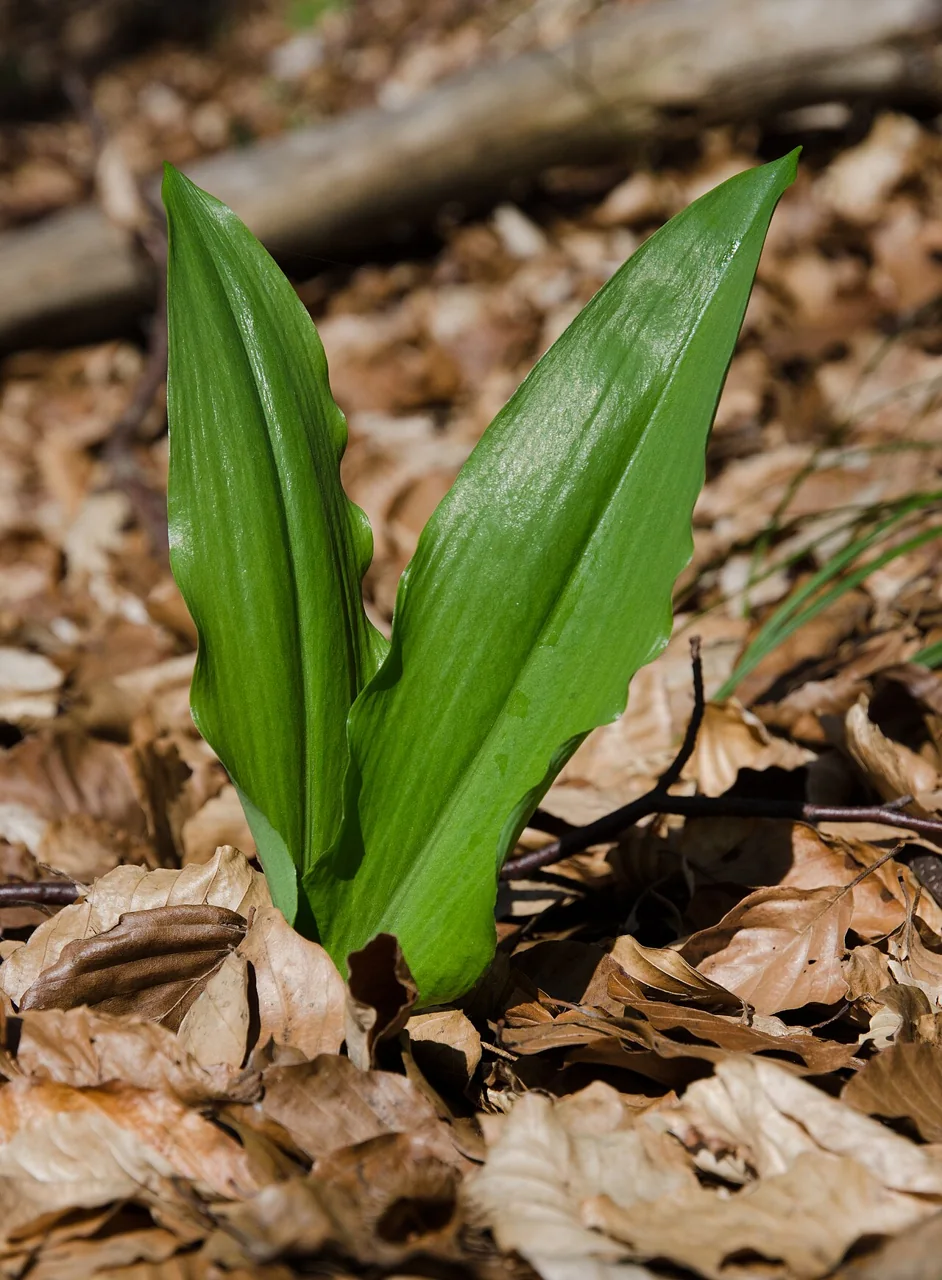
Young wild garlic leaves emerging through leaf litter.
Dietrich Krieger / Wikimedia Commons / CC BY-SA 3.0

Photo details
Resized and converted to WebP. No content edits.
Source: File:Deggenhausertal-1552.jpg
Reviewed . Source identification and visible plant parts reviewed against this plant record.
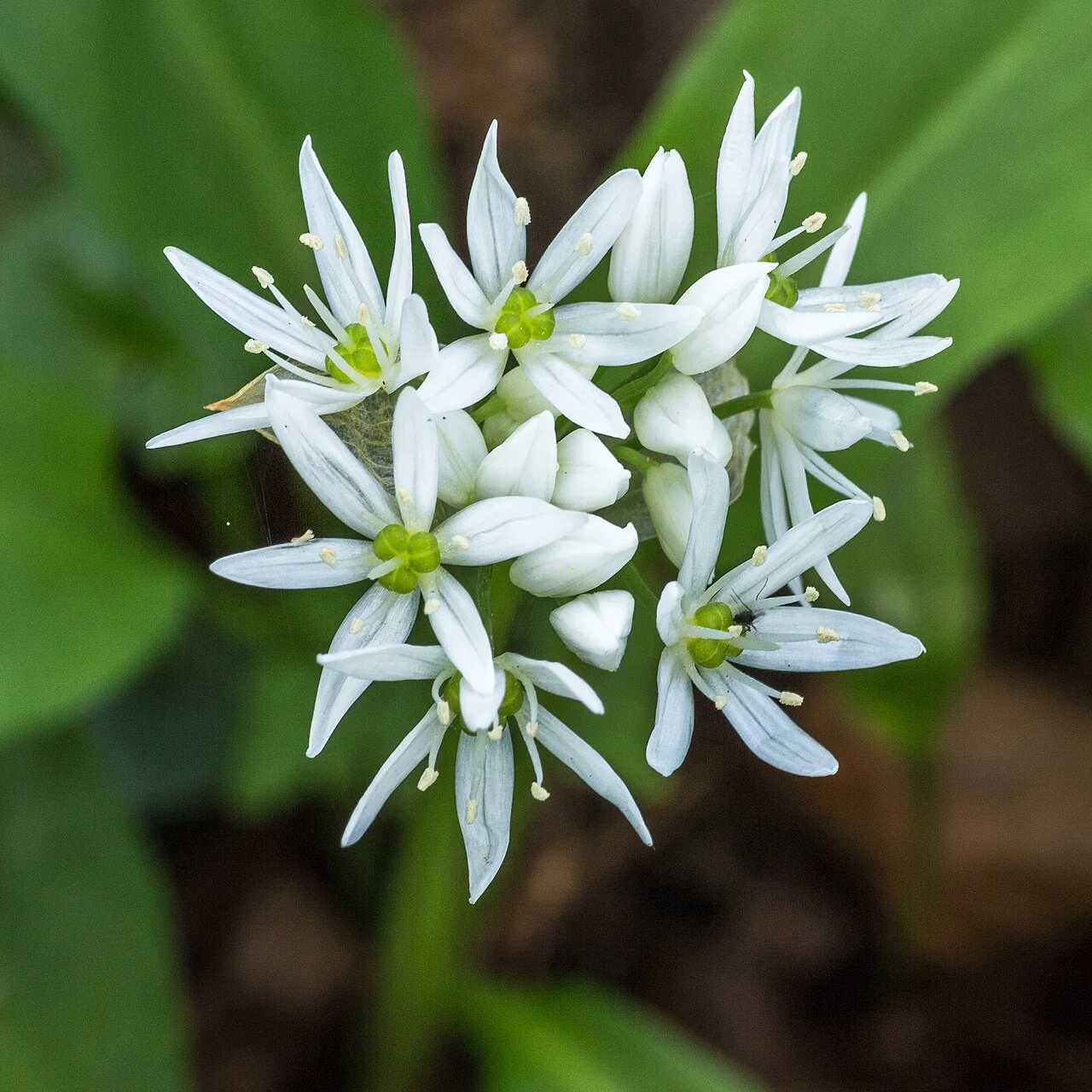
White wild garlic flowers in a rounded cluster.
Agnes Monkelbaan / Wikimedia Commons / CC BY-SA 4.0
_07-04-2020._(actm.)_04.jpg)
Photo details
Resized and converted to WebP. No content edits.
Source: File:Daslook (Allium ursinum) 07-04-2020. (actm.) 04.jpg
Reviewed . Source identification and visible plant parts reviewed against this plant record.
Common names
54 names · 39 languagesOther languages (38)
- Dutch
-
- Daslook[1]
- French
-
- Ail des ours[1]
- Ainu
-
- プクサ[1]
- Albanian
-
- Lerthi[1]
- Armenian
-
- Ղանձիլ[1]
- Asturian
-
- Ayo ursino[1]
- Basque
-
- Hartz-baratxuri[1]
- Belarusian
-
- Цыбуля мядзведжая, ці Чарамша[1]
- Bulgarian
-
- Левурда[1]
- Catalan
-
- all d'ós[1]
- Chechen
-
- Хьонка[1]
- Chinese (Traditional)
-
- 熊葱[1]
- Danish
-
- Rams-løg[1]
- Estonian
-
- Karulauk[1]
- Finnish
-
- karhunlaukka[1]
- German
-
- Bärlauch[1]
- Hungarian
-
- Medvehagyma[1]
- Icelandic
-
- Bjarnarlaukur[1]
- Irish
-
- Creamh[1]
- Italian
-
- Aglio orsino[1]
- Latvian
-
- Laksis[1]
- Lithuanian
-
- Meškinis česnakas[1]
- Old English
-
- Hramsa[1]
- Polish
-
- Czosnek niedźwiedzi[1]
- Slovenian
-
- čemaž[1]
- Spanish
-
- Ajo de oso[1]
- Swedish
-
- Ramslök[1]
- Tuvinian
-
- Хылба[1]
- Walloon
-
- A des oûsses[1]
- Welsh
-
- Craf y geifr[1]
Sources & name notes (1)
Names recorded in our plant catalogue and botanical sources, grouped by language. Usage can vary by region.
Numbered references identify names recorded by an external source. Other names are from our plant catalogue.
Community-curated iNaturalist taxonomy; common-name attestation, not an independent botanical determination.
Source records
- Ramsons — results[0].names[1]; taxon id 56152; Allium ursinum.
- Daslook — results[0].names[2]; taxon id 56152; Allium ursinum.
- Ramslök — results[0].names[3]; taxon id 56152; Allium ursinum.
- Bärlauch — results[0].names[4]; taxon id 56152; Allium ursinum.
- all d'ós — results[0].names[5]; taxon id 56152; Allium ursinum.
- karhunlaukka — results[0].names[6]; taxon id 56152; Allium ursinum.
- Черемша — results[0].names[7]; taxon id 56152; Allium ursinum.
- Ail des ours — results[0].names[8]; taxon id 56152; Allium ursinum.
- Wild garlic — results[0].names[9]; taxon id 56152; Allium ursinum.
- Karulauk — results[0].names[10]; taxon id 56152; Allium ursinum.
- Bjarnarlaukur — results[0].names[11]; taxon id 56152; Allium ursinum.
- Lerthi — results[0].names[12]; taxon id 56152; Allium ursinum.
- Hramsa — results[0].names[13]; taxon id 56152; Allium ursinum.
- Hartz-baratxuri — results[0].names[14]; taxon id 56152; Allium ursinum.
- Creamh — results[0].names[15]; taxon id 56152; Allium ursinum.
- Хьонка — results[0].names[16]; taxon id 56152; Allium ursinum.
- Левурда — results[0].names[17]; taxon id 56152; Allium ursinum.
- Хылба — results[0].names[18]; taxon id 56152; Allium ursinum.
- Цибуля ведмежа — results[0].names[19]; taxon id 56152; Allium ursinum.
- A des oûsses — results[0].names[20]; taxon id 56152; Allium ursinum.
- česnek medvědí — results[0].names[21]; taxon id 56152; Allium ursinum.
- Rams-løg — results[0].names[22]; taxon id 56152; Allium ursinum.
- Medvehagyma — results[0].names[23]; taxon id 56152; Allium ursinum.
- Ayo ursino — results[0].names[24]; taxon id 56152; Allium ursinum.
- ramslauk — results[0].names[25]; taxon id 56152; Allium ursinum.
- ramsløk — results[0].names[26]; taxon id 56152; Allium ursinum.
- Meškinis česnakas — results[0].names[27]; taxon id 56152; Allium ursinum.
- 熊韭 — results[0].names[28]; taxon id 56152; Allium ursinum.
- Czosnek niedźwiedzi — results[0].names[29]; taxon id 56152; Allium ursinum.
- cesnak medvedí — results[0].names[30]; taxon id 56152; Allium ursinum.
- Ղանձիլ — results[0].names[31]; taxon id 56152; Allium ursinum.
- プクサ — results[0].names[32]; taxon id 56152; Allium ursinum.
- 熊蒜 — results[0].names[33]; taxon id 56152; Allium ursinum.
- ramps — results[0].names[34]; taxon id 56152; Allium ursinum.
- ramp — results[0].names[35]; taxon id 56152; Allium ursinum.
- Лук медвежий — results[0].names[36]; taxon id 56152; Allium ursinum.
- leurdă — results[0].names[37]; taxon id 56152; Allium ursinum.
- usturoi sălbatic — results[0].names[38]; taxon id 56152; Allium ursinum.
- usturoiul ursului — results[0].names[39]; taxon id 56152; Allium ursinum.
- Aglio orsino — results[0].names[40]; taxon id 56152; Allium ursinum.
- 熊葱 — results[0].names[41]; taxon id 56152; Allium ursinum.
- 熊葱 — results[0].names[42]; taxon id 56152; Allium ursinum.
- Цыбуля мядзведжая, ці Чарамша — results[0].names[43]; taxon id 56152; Allium ursinum.
- čemaž — results[0].names[44]; taxon id 56152; Allium ursinum.
- Цибуля ведмежа (Черемша) — results[0].names[45]; taxon id 56152; Allium ursinum.
- Laksis — results[0].names[46]; taxon id 56152; Allium ursinum.
- Divlji luk — results[0].names[47]; taxon id 56152; Allium ursinum.
- Craf y geifr — results[0].names[48]; taxon id 56152; Allium ursinum.
- Ajo de oso — results[0].names[49]; taxon id 56152; Allium ursinum.
- Medveđi luk — results[0].names[50]; taxon id 56152; Allium ursinum.
- cesnak medvedí pravý — results[0].names[51]; taxon id 56152; Allium ursinum.
- Цибуля ведмежа українська — results[0].names[52]; taxon id 56152; Allium ursinum.
- česnek medvědí ukrajinský — results[0].names[53]; taxon id 56152; Allium ursinum.
- cesnak medvedí ukrajinský — results[0].names[54]; taxon id 56152; Allium ursinum.
General information
Kew's family placement for the genus Allium (WCVP v16).
Sources [1]Plant characteristics
Growing conditions
Moist
Sand (light) Loam (medium)
Acidic Neutral Alkaline
Shade, Partial shade
Uses
Leaves, Flowers, Root
Companion plant, Repellent, Disinfectant
Description
Leaves can be eaten raw or cooked and are usually available from the end of January. Although some reports suggest that they have a strong garlic odor that decreases with cooking, most people find them significantly milder than garlic. The leaves are a delicious addition to salads and provide a welcome dose of fresh greens during the winter. Flowers can be eaten both raw and cooked. They are slightly stronger in flavor than the leaves and can be decorative and tasty in small amounts in salads. The flower buds can be eaten while the seed pods are forming, but the flavor becomes stronger as the seeds mature. The bulbs have a fairly strong garlic flavor and can be consumed raw or cooked. However, they are small and difficult to harvest. The bulbs can be harvested from early summer to early winter while the plant is dormant. When harvested in early summer, they can be stored for at least 6 months. The bulbs can grow up to 4 cm long and 1 cm in diameter, and the small green bulbs can serve as a substitute for capers.
Harvest
Sources and references
References for the information marked with source numbers on this page.
-
Royal Botanic Gardens, Kew
World Checklist of Vascular Plants, version 16, extracted 4 June 2026
Relevant sections
- Botanical family: WCVP v16, wcvp_names.csv row 1169904; name ID 294888; Allium L.. Family column.
- Taxonomy: WCVP v16, wcvp_names.csv row 260326; name ID 296893; Allium ursinum L..
Source checked on .
Source data licence: CC BY 3.0.
-
Catalogue of Life
Catalogue of Life 2026-08-20 — Allium ursinum
Taxonomic data from WCVP, version 16.0, reproduced in Catalogue of Life 2026-08-20. This shares the Kew WCVP evidence base cited on this page.
Supports: TaxonomyRelevant sections
- Taxonomy: COL 2026-08-20, NameUsage.tsv line 1939966, ID 65X8C: Allium ursinum L. (accepted).
Source checked on .